Fifth wheel hitches
Which puck system fifth wheel hitch fits your truck?
A puck system is a set of threaded mounting holes some trucks come with from the factory, molded straight into the bed floor and covered with plastic caps when nothing is installed. A hitch built for that specific puck pattern bolts straight in with no rails, no brackets and no drilling, which is the cleanest fifth wheel install available on any truck.
The catch is that puck patterns are brand specific. A Ford puck hitch does not fit a GM puck pattern and neither fits a truck with no factory pucks at all, so the first step is confirming your own truck actually has the prep package rather than shopping by price alone. Pucks are usually visible as a neat grid of plastic caps in the bed floor, ahead of the tailgate, on a truck ordered with the towing prep option.
Everything else about a fifth wheel still applies here exactly as it does on a rail-mounted hitch. Pin weight runs 15 to 25 percent of the loaded trailer weight, and every pound of it lands on your truck's payload rather than being distributed anywhere. A clean puck install does not change that arithmetic in the slightest.
On this page
Beginner: the lower cost GM puck hitch
The most affordable way into the puck platform on a GM truck that already has it.
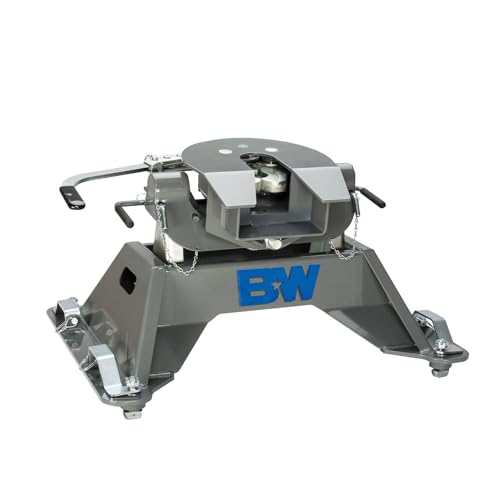
B&W Companion OEM Puck Fifth Wheel Hitch for Chevrolet and GMC, 20,000 lb
$1,199.00 Published ratingsDrops into the Chevrolet and GMC factory puck system at 20,000 lb GTW, with the same cam action, kingpin-wrapping head as every other Companion, just at a lower rating and price.
Best for: A GM truck with the factory puck system pulling a typical fifth wheel RV.
Check price on AmazonIntermediate: a wider, more precise head
Same puck footprint, a different jaw design, and a genuine step up in fit and finish.

CURT A25 Fifth Wheel Hitch for GM Puck System, 25,000 lb
$1,366.95 Published ratingsCast yoke with poly-torsion inserts to suppress shock loads, an extra wide head opening for easier coupling, and interlocking jaws that fully wrap the kingpin, rated at 25,000 lb for the GM puck system.
Best for: Somebody who wants a genuine upgrade in coupling ease over the base Companion, on a GM truck.
Check price on AmazonExpert: the highest rated puck hitch here
B&W Companion OEM Puck Fifth Wheel Hitch for Chevrolet and GMC, 25,000 lb
$1,399.00 Published ratingsThe 25,000 lb version of the Companion cam action head on the GM puck platform, for a large fifth wheel or a toy hauler where the 20K version is too close to the trailer's actual loaded weight for comfort.
Best for: A GM dually or heavy duty truck pulling a large fifth wheel or a toy hauler.
Check price on AmazonWho should not buy this tier: A Ram truck. Every puck-mounted hitch cataloged here, from both B&W and CURT, is built for the Ford or GM/Chevrolet puck pattern specifically. See the Ram note below rather than assuming one of these will bolt in.
What is a puck system, and how is it different from rails?
A puck system is threaded holes cast into the bed floor at the factory, so a matching hitch bolts straight down with no under-bed brackets at all. A rail-mounted hitch instead bolts to a pair of base rails that themselves bolt or weld to the truck frame, which fits nearly any truck but is a real install with real labor. If your truck's bed already has puck covers from the factory tow prep package, a puck hitch is almost always the cleaner and cheaper install of the two.
Puck hitches compared by truck brand
B&W Companion OEM Puck Fifth Wheel Hitch for Ford, 25,000 lb is the only Ford-compatible pick here; every other puck hitch cataloged fits GM/Chevrolet only.
Published standard A published, traceable figure: a standards body, a federal regulation or a manufacturer specification states it.
| Hitch | Compatible puck system | GTW rating | Price |
|---|---|---|---|
| B&W Companion OEM Puck Fifth Wheel Hitch for Ford, 25,000 lb | Ford OEM | 25,000 lb | $1,399.00 |
| B&W Companion OEM Puck Fifth Wheel Hitch for Chevrolet and GMC, 20,000 lb | GM OEM | 20,000 lb | $1,199.00 |
| B&W Companion OEM Puck Fifth Wheel Hitch for Chevrolet and GMC, 25,000 lb | GM OEM | 25,000 lb | $1,399.00 |
| CURT A20 Fifth Wheel Hitch for GM Puck System, 20,000 lb | GM OEM | 20,000 lb | $1,311.95 |
| CURT A25 Fifth Wheel Hitch for GM Puck System, 25,000 lb | GM OEM | 25,000 lb | $1,366.95 |
Confirm your own puck pattern against the specific model before ordering. A hitch built for the wrong brand of puck simply will not line up with the holes.
How do you actually confirm your truck has the puck system?
- Look at the bed floor ahead of the tailgate. A factory puck system shows up as a neat grid of round plastic caps set flush into the bed floor, usually in two rows, rather than any visible hardware.
- Pop a cap and look for threads. Underneath each cap is a threaded insert rather than a bare hole. If you see raw sheet metal with no threading, the truck does not have the puck package regardless of what the trim level or towing package sticker implies.
- Check the build sheet or window sticker. The factory towing prep package, including pucks, is an ordered option on most trucks that offer it, so a build sheet or the original window sticker will list it by name if the dealer kept a copy.
- Match the brand exactly. A Ford puck pattern and a GM puck pattern are not interchangeable, and neither fits a truck with a plain gooseneck prep hole instead of a full puck grid. Confirm both the presence of pucks and the specific truck brand before ordering a hitch.
- Measure if you are still unsure. Puck spacing is published by each hitch manufacturer for its compatible trucks. When in doubt, measure the actual hole spacing on your bed against the spec sheet for the hitch you are considering rather than trusting the model year alone.
How we chose
We did not test this hardware in person and we never claim to. Picks are researched from manufacturer specification sheets, published towing standards, and the recurring themes in verified owner reviews. Every pick is matched to a real gross trailer weight rating, a real tongue or pin weight rating, a real receiver size or a real load index rather than to a price bracket, and it is placed in the tier where its published capability actually belongs. We rejected the unbranded flood that dominates the search results in several of these categories, because a weight distribution hitch, a brake controller, a trailer tire and a set of safety chains are all parts whose failure puts a loose trailer on a public road. Where a figure is towing convention rather than a published standard we label it that way, and where a manufacturer does not publish a figure we leave it out instead of estimating it.
Frequently asked questions
What is a puck system on a pickup truck?
It is a grid of threaded mounting holes molded into the bed floor at the factory, usually covered with plastic caps when nothing is installed. A hitch built for that exact puck pattern bolts straight down into the holes with no rails, no under-bed brackets and no drilling, which is the cleanest fifth wheel install a truck can have.
Which pickup brands come with a factory puck system?
Ford and GM both offer factory puck patterns on trucks ordered with the towing prep package, and the hitches in this catalog are built specifically for one or the other. Check your own bed floor for the plastic puck covers, usually ahead of the tailgate, rather than assuming from the trim level alone.
Can I add a puck system to a truck that does not have one?
Some trucks can be retrofitted, but it means drilling into the bed floor to match the factory pattern, which is a dealer or frame shop job rather than a weekend bolt-on project. If your truck has no pucks, a rail-mounted fifth wheel hitch is almost always the more practical route.
Is a puck-mounted hitch stronger than a rail-mounted one?
Not inherently. Both mounting styles are rated by their own manufacturer to a specific GTW figure, and the puck-mounted B&W Companion and CURT A-series reach the same 20,000 to 25,000 lb range as the rail-mounted hitches on this site. Choose by which mounting your truck actually has, not by an assumption about strength.
Does Ram have a puck-mounted fifth wheel hitch option?
We could not verify one in this catalog. Ram trucks with the factory gooseneck prep hole can instead use an OEM gooseneck ball kit paired with a fifth wheel to gooseneck adapter, which is a genuine and cataloged alternative, or you can search current listings directly for a Ram-specific puck hitch before buying.
Do I still need to check payload if my truck already has factory pucks?
Yes, completely unchanged. The puck system only decides how the hitch bolts to the truck. Pin weight still runs 15 to 25 percent of the loaded trailer weight and it still comes entirely out of your payload rating, so the door jamb sticker matters exactly as much on a puck-equipped truck as on a rail-mounted one.
Free download
Get the complete tow rig setups emailed to you
Both ladders, conventional travel trailer and fifth wheel, at beginner, intermediate and expert budgets, every item priced and linked with a running total, plus a printable pre-trip weighing worksheet you can fill in at the scale.
One email with the setups. No sequence, no sharing your address, unsubscribe any time.
Researched, not professional advice. This page is compiled from published standards, manufacturer towing guides and product specifications, and owner-review consensus, not hands-on testing. Figures described as a rule of thumb are towing convention rather than published standards, and they are labelled that way wherever they appear. Nothing here overrides your own ratings. Work your payload sum before your tow rating, because payload is the limit that actually binds on most half ton trucks and nearly every SUV. Load a conventional trailer to 10 to 15 percent tongue weight and a fifth wheel to 15 to 25 percent pin weight, and never lighter: a tail heavy trailer is what starts sway. Weigh the rig loaded rather than trusting a brochure dry weight. A weight distribution hitch and a set of air bags both restore ride height and control, and neither one raises a single rating. Trailer brakes are required by state law above a threshold that varies by state, and a breakaway battery that has quietly gone flat is the normal condition of most trailers on the road.