Weights and capacities
How much GCWR headroom do you have?
GCWR is one of four separate limits, and the lowest of them governs. Most people only ever hear about the tow rating, and on a half ton truck or an SUV it is rarely the one that binds.
- Payload, from the yellow door jamb sticker. Usually the first to run out.
- GAWR, per axle, which a heavy tongue or pin can exhaust while the vehicle is still inside its GVWR.
- GVWR, the most the vehicle alone may weigh.
- GCWR, the most the vehicle and trailer may weigh together. This page.
Get both weights from a public scale rather than from brochures. Trailers routinely weigh well over a thousand pounds more loaded than the dry weight suggested.
Check the combined weight
2,600 lb of headroom, using 84% of GCWR. Legal, but above the 80 percent comfort target.
| Figure | Value |
|---|---|
| Combined weight | 13,400 lb |
| GCWR | 16,000 lb |
| Headroom | 2,600 lb |
| Share of GCWR used | 84% |
Shown with the example figures above. Change any field to run your own numbers.
The working
From your own vehiclecombined = loaded tow vehicle weight + loaded trailer weight headroom = GCWR - combined used = combined / GCWR
GCWR is a vehicle-specific figure from your owner manual or manufacturer towing guide. This number exists only on your own vehicle and trailer. Read it off the door jamb sticker, the trailer certification label or the owner manual.
For a rig working high in its GCWR
A sustained grade climb at weight is the hottest an automatic transmission will ever get. A cooler does not raise any rating, it means the rating is reached with the transmission still in range.

Mishimoto Transmission Cooler for Ram 2500 to 5500 Cummins
$556.11A direct fit rather than a universal kit, which removes the bracket fabrication and the hose routing guesswork that makes a universal install go wrong.
Best for: A 2003 to 2009 Ram Cummins used for heavy towing.
Check price on Amazon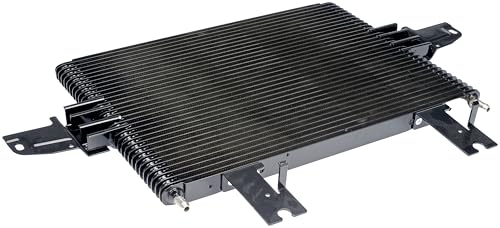
Dorman Automatic Transmission Oil Cooler for Ford
$219.78A vehicle specific replacement cooler for select Ford models, which is the right answer when the factory cooler has failed rather than when you want more capacity.
Best for: Replacing a failed factory cooler on a Ford.
Check price on Amazon
Sherline LM 1000 Trailer Tongue Weight Scale, 1,000 lb
$189.90Sherline is the scale the towing community actually uses, and a 1,000 lb capacity covers most travel trailers. Hydraulic, with no batteries to be dead when you need it.
Best for: A trailer whose tongue weight is under 1,000 lb.
Check price on Amazon
Sherline LM 2000 Trailer Tongue Weight Scale, 2,000 lb
$189.90Double the capacity for the same money as the LM 1000, which makes it the sensible default unless you are certain your tongue weight is low.
Best for: Most travel trailers, with headroom for a heavier one later.
Check price on Amazon
Mishimoto Universal 13-Row Stacked Plate Transmission Cooler Kit
$159.95Stacked plate rather than tube and fin, which moves substantially more heat for the same frontal area. Thirteen rows is a serious cooler rather than a token one.
Best for: A tow vehicle that climbs real grades with a heavy trailer.
Check price on Amazon
Hayden Automotive Rapid-Cool Add-On Transmission Cooler
$55.95The cheapest credible auxiliary cooler here, from a maker that has been in this category for decades. A modest cooler fitted is worth far more than a large one you did not buy.
Check before buying: Hayden states this is an add-on cooler rather than a direct replacement for the factory unit, so it goes in series with what is already there.
Best for: A first transmission cooler on a half ton truck.
Check price on AmazonEvery rating shown is the manufacturer's own published figure. The rating on the part you receive is what governs, and your own door jamb sticker governs everything above it.
Why the 80 percent target exists
There is nothing magic about 80 percent and no standards body publishes it. It exists because a rig at 100 percent of every rating has no margin for the things that actually happen: a long climb on a hot day, a headwind, extra passengers on the way home, a full fresh tank you did not plan on.
Staying under about 80 percent of a rating leaves margin for heat, grade, wind and the weight you did not plan on.
Rule of thumb Widely taught towing convention rather than a published specification. It is a good starting point and it is not a rating.
| Share of GCWR used | What it feels like |
|---|---|
| Under 70 percent | The rig is comfortable. Grades and headwinds are uneventful. |
| 70 to 80 percent | Normal working territory for a well matched rig. |
| 80 to 95 percent | Legal but hard work. Long climbs get hot and passing takes planning. |
| Over 100 percent | Over the rating. The braking and cooling the manufacturer validated no longer apply. |
This is towing convention, not a specification. The rating itself is the limit; the 80 percent figure is about how the rig behaves well below it.
What SAE J2807 actually is
The tow rating test methodology light duty manufacturers use. It defines a launch test on a grade, a sustained grade climb, highway handling and a cooling test, all at a specified combined weight with specified occupants.
It makes one maker rating comparable to another, and it is why several published tow ratings fell when manufacturers adopted it. It produces a rating rather than being one, so no figure on this site is derived from it.
The practical point: a tow rating is produced by a test rather than being a property you can derive. Nothing on this site can calculate one for you, and a rating belongs to one exact configuration of engine, axle ratio, cab, bed and drivetrain rather than to a model name.
Heat is the real constraint on a long climb
GCWR exists partly because of cooling. A sustained grade climb at weight is the hottest an engine and an automatic transmission will ever get, and it is where a marginal rig actually fails rather than on flat interstate.
If your climbs are long and your rig sits high in its GCWR, an auxiliary transmission cooler is cheap next to a rebuild. It does not raise any rating, it just means the rating is reached with the transmission still in its temperature range.
Frequently asked questions
What is GCWR?
Gross combined weight rating: the most your tow vehicle and trailer may weigh together, fully loaded, including passengers, fuel, cargo and everything in the trailer. It is a vehicle-specific figure from your manufacturer. It is a separate limit from payload, GVWR and the axle ratings, and the lowest of all of them is your real constraint.
What is the difference between GVWR and GCWR?
GVWR is the most the vehicle alone may weigh on its own wheels, loaded. GCWR covers the vehicle and the trailer together. You can be inside your GVWR and still over your GCWR with a heavy enough trailer, and you can be inside your GCWR while over your payload, which is why all four limits have to be checked separately.
Where do I find my GCWR?
In the owner manual or the manufacturer towing guide for your exact configuration, rather than on the door jamb sticker, which carries payload and the axle ratings. It varies with engine, axle ratio, cab and drivetrain, so a figure quoted for the same model with different options will be the wrong number for your vehicle.
Is 80 percent of GCWR a real rule?
It is towing convention rather than a published standard. It exists because a rig at 100 percent of every rating has no margin for a hot day, a long climb, a headwind or the extra weight nobody planned on. The rating is the legal limit; the 80 percent figure is about how the rig behaves comfortably below it.
What is SAE J2807?
The tow rating test methodology light duty manufacturers use. It defines a launch test on a grade, a sustained grade climb, highway handling and a cooling test, all at a specified combined weight with specified occupants. It makes one maker rating comparable to another, and it is why several published tow ratings fell when manufacturers adopted it. It produces a rating rather than being one.
Which limit usually runs out first?
Payload, on most half ton trucks and nearly every SUV. A published tow rating assumes a driver and nothing else, while tongue weight is 10 to 15 percent of the trailer and pin weight is 15 to 25 percent. Add passengers, gear and the hitch and the payload sum fails long before the combined weight approaches GCWR.
Free download
Get the complete tow rig setups emailed to you
Both ladders, conventional travel trailer and fifth wheel, at beginner, intermediate and expert budgets, every item priced and linked with a running total, plus a printable pre-trip weighing worksheet you can fill in at the scale.
One email with the setups. No sequence, no sharing your address, unsubscribe any time.
Researched, not professional advice. This page is compiled from published standards, manufacturer towing guides and product specifications, and owner-review consensus, not hands-on testing. Figures described as a rule of thumb are towing convention rather than published standards, and they are labelled that way wherever they appear. Nothing here overrides your own ratings. Work your payload sum before your tow rating, because payload is the limit that actually binds on most half ton trucks and nearly every SUV. Load a conventional trailer to 10 to 15 percent tongue weight and a fifth wheel to 15 to 25 percent pin weight, and never lighter: a tail heavy trailer is what starts sway. Weigh the rig loaded rather than trusting a brochure dry weight. A weight distribution hitch and a set of air bags both restore ride height and control, and neither one raises a single rating. Trailer brakes are required by state law above a threshold that varies by state, and a breakaway battery that has quietly gone flat is the normal condition of most trailers on the road.