Weighing and levelling
Which tongue weight scale should you actually buy?
Tongue weight is the single most useful number an owner of a bumper pull trailer can know, because it is the number that decides whether the trailer tracks straight or starts to sway, and almost nobody actually measures theirs. A scale takes that number out of guesswork entirely. Put it under the coupler with the trailer loaded the way you tow, and it hands back a real figure in pounds instead of a feeling about how the rig sits.
You do not strictly need to buy anything to get this number. The public scale method is free: weigh the entire rig hitched at any commercial scale, unhitch, weigh the tow vehicle alone at the same scale, and the difference between the two readings is your tongue weight. It also hands you your real loaded trailer weight in the same trip, which the tongue weight percentage depends on. A dedicated scale earns its price by letting you check the number in your own driveway, any time you change what is loaded on the trailer, rather than driving to a scale house each time.
Capacity matters more than most buyers expect. A conventional travel trailer tongue weight generally falls under 1,500 lb, well inside the smaller scales here, but a fifth wheel pin weight runs 15 to 25 percent of a trailer that can weigh 12,000 lb or more, which puts the reading well past what a 1,000 or 2,000 lb scale is built to take. Buy the capacity that matches what you are actually weighing, not the cheapest scale on the page.
On this page
Beginner: a digital readout without a hydraulic gauge to misread
A digital display removes the parallax error that makes a hydraulic dial hard to read accurately when it is sitting on the ground under a trailer tongue.

B&W Digital Tongue Weight Scale
$149.00A digital LED readout up to 4,000 lb capacity, with a height-adjustable steel base and a hard storage case, at the lowest price on this page.
Best for: Reading a precise figure without lying on the driveway to sight a dial straight on.
Check price on AmazonIntermediate: double the capacity for the same money
This is the buy-once pick for a conventional travel trailer, because it covers a wider range than the entry model at an identical price.

Sherline LM 2000 Trailer Tongue Weight Scale, 2,000 lb
$189.90A 2,000 lb capacity hydraulic scale from the brand the towing community names most often, with no batteries and nothing to go dead when you need it.
Best for: Most travel trailers, with headroom for a heavier one later without needing a second scale.
Check price on AmazonExpert: rated for a fifth wheel pin, not a bumper pull tongue
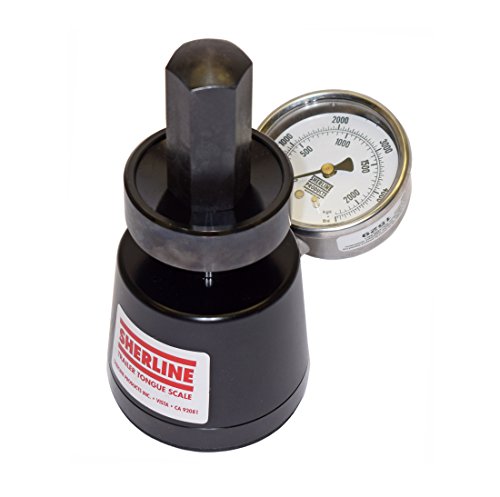
Sherline LM-5000 Trailer Tongue Weight Scale, 5,000 lb
$189.90A 5,000 lb capacity, which is what it actually takes to weigh a fifth wheel pin rather than a bumper pull tongue, from the same hydraulic design used across the whole Sherline line.
Best for: Weighing fifth wheel pin weight at home rather than only at a public scale.
Check price on AmazonWho should not buy this tier: A light bumper pull trailer with a tongue weight well under 1,000 lb. A 5,000 lb scale reads that low a figure with less useful resolution than the LM 1000 or LM 2000, so buy the capacity that matches what you are actually weighing rather than the biggest number on the page.
How we chose
Searching this category outside a small number of names turns up mostly unbranded sellers with no published capacity figure that could be traced back to a real manufacturer, which on a site about load ratings is exactly the kind of unverifiable number we will not put in front of a reader. Sherline came up consistently in verified owner discussions as the scale the towing community actually reaches for, and B&W is a known towing hardware maker with a digital alternative that solves a specific reading problem rather than duplicating Sherline. This catalog does not include the wider unbranded field, and that is a deliberate choice rather than an oversight.
The free method: weighing without buying anything
- Load the rig the way you actually travel. Water, propane, batteries and cargo aboard. An unloaded weigh-in tells you nothing useful about the trip you are actually taking.
- Weigh the whole rig hitched. At any commercial scale, truck and trailer together, and record the total.
- Unhitch and weigh the tow vehicle alone. Same scale, same visit, same fuel level as the first weigh-in.
- Subtract the two readings. The tow vehicle weight with the trailer hitched, minus the tow vehicle weight alone, is your tongue weight. The difference in the truck reading is the number, not the trailer total.
- Note your real loaded trailer weight too. The same visit gives you the trailer total weight, which the 10 to 15 percent tongue weight band and the 15 to 25 percent pin weight band are both calculated against.
Scales compared by capacity
The Sherline LM 2000 Trailer Tongue Weight Scale, 2,000 lb and Sherline LM 1000 Trailer Tongue Weight Scale, 1,000 lb cost the same at $189.90, and only the 5,000 lb models are rated for a fifth wheel pin.
Published standard A published, traceable figure: a standards body, a federal regulation or a manufacturer specification states it.
| Scale | Capacity | Readout | Price |
|---|---|---|---|
| B&W Digital Tongue Weight Scale | 4,000 lb | Digital LED | $149.00 |
| Sherline LM 1000 Trailer Tongue Weight Scale, 1,000 lb | 1,000 lb | Hydraulic gauge | $189.90 |
| Sherline LM 2000 Trailer Tongue Weight Scale, 2,000 lb | 2,000 lb | Hydraulic gauge | $189.90 |
| Sherline LM-5000 Trailer Tongue Weight Scale, 5,000 lb | 5,000 lb | Hydraulic gauge | $189.90 |
| Sherline Hydraulic Tongue Weight Scale, 0 to 5,000 lb with dual scale gauge | 5,000 lb | Dual lb and kg gauge | $199.95 |
| Sherline Hydraulic Tongue Weight Scale Combo with 2,000 lb and 5,000 lb Gauges | 2,000 and 5,000 lb | Two gauges on one body | $229.95 |
The combo unit is worth the extra cost only if you regularly weigh both a light bumper pull and a heavy fifth wheel pin, since a single 5,000 lb gauge reads a light tongue weight with less usable resolution.
How we chose
We did not test this hardware in person and we never claim to. Picks are researched from manufacturer specification sheets, published towing standards, and the recurring themes in verified owner reviews. Every pick is matched to a real gross trailer weight rating, a real tongue or pin weight rating, a real receiver size or a real load index rather than to a price bracket, and it is placed in the tier where its published capability actually belongs. We rejected the unbranded flood that dominates the search results in several of these categories, because a weight distribution hitch, a brake controller, a trailer tire and a set of safety chains are all parts whose failure puts a loose trailer on a public road. Where a figure is towing convention rather than a published standard we label it that way, and where a manufacturer does not publish a figure we leave it out instead of estimating it.
Frequently asked questions
Do I need a dedicated scale if the public scale method is free?
Not strictly, and the free method gives you an accurate number. A dedicated scale earns its price by letting you check tongue weight in your own driveway any time you change what is loaded, rather than making a trip to a commercial scale house each time. Owners who load and unload frequently tend to find the convenience worth the one-time cost.
What capacity scale do I need for a fifth wheel versus a bumper pull?
A bumper pull tongue weight generally falls under 1,500 lb, well inside a 1,000 or 2,000 lb scale. A fifth wheel pin weight runs 15 to 25 percent of a trailer that can weigh well over 10,000 lb, which requires a 5,000 lb rated scale. Using an undersized scale on a fifth wheel pin risks damaging the scale and getting a meaningless reading.
Is Sherline the only trustworthy brand for a tongue weight scale?
It is the name that comes up most consistently among verified towing community discussions and the one most widely stocked with a clearly published capacity. A digital alternative from B&W solves a specific reading problem, parallax error on a dial gauge, rather than duplicating what Sherline already does. Outside these names, this category is dominated by unbranded sellers with no traceable published rating.
Can I use a bathroom scale or a luggage scale instead?
No. Neither is built to take the concentrated point load a trailer coupler applies, and the reading you get will not reflect the real figure, if the scale survives the load at all. The 10 to 15 percent tongue weight band this whole site references only means something when the number behind it came from equipment actually rated for the job.
How accurate does a tongue weight reading need to be?
Accurate enough to place you confidently inside the 10 to 15 percent conventional band, not laboratory precise. A scale reading that is off by a small amount still tells you whether you are dangerously light, comfortably inside the band, or pushing the rear axle too hard, which is the decision that actually matters.
What is the free public-scale method exactly?
Weigh the truck and trailer together, hitched, at a commercial scale. Unhitch and weigh the truck alone at the same scale on the same visit. The difference between the two truck readings is your tongue weight, and the same visit also gives you your real loaded trailer weight, both without buying any equipment.
Free download
Get the complete tow rig setups emailed to you
Both ladders, conventional travel trailer and fifth wheel, at beginner, intermediate and expert budgets, every item priced and linked with a running total, plus a printable pre-trip weighing worksheet you can fill in at the scale.
One email with the setups. No sequence, no sharing your address, unsubscribe any time.
Researched, not professional advice. This page is compiled from published standards, manufacturer towing guides and product specifications, and owner-review consensus, not hands-on testing. Figures described as a rule of thumb are towing convention rather than published standards, and they are labelled that way wherever they appear. Nothing here overrides your own ratings. Work your payload sum before your tow rating, because payload is the limit that actually binds on most half ton trucks and nearly every SUV. Load a conventional trailer to 10 to 15 percent tongue weight and a fifth wheel to 15 to 25 percent pin weight, and never lighter: a tail heavy trailer is what starts sway. Weigh the rig loaded rather than trusting a brochure dry weight. A weight distribution hitch and a set of air bags both restore ride height and control, and neither one raises a single rating. Trailer brakes are required by state law above a threshold that varies by state, and a breakaway battery that has quietly gone flat is the normal condition of most trailers on the road.