Visibility and backing
Which towing mirror should you actually buy?
A trailer wider than the tow vehicle blocks the view a standard mirror is built to give, which is exactly the situation extended towing mirrors exist to fix. Whether that is a legal requirement where you drive varies by state rather than following one national rule, the same way the trailer brake threshold does. Some states specify a clear test, being able to see 200 feet behind the vehicle in each mirror, others phrase it around whatever width the towed unit adds. Check your own state DMV or DOT site rather than assuming a figure that applies somewhere else.
Two genuinely different products solve this. A clip-on mirror mounts over the existing mirror glass in seconds with no tools, extending the field of view outward, and it is universal across nearly any vehicle. A vehicle-specific mirror clamps or slides over the factory mirror housing in a defined, engineered position rather than one adjusted by feel, and it typically does not obstruct the original glass at all.
That last point is not a minor detail on a modern truck. Many factory mirrors have a blind spot indicator light built directly into the glass, and a clip-on that covers the mirror face covers that light along with it. It is a real trade for the lowest price and the fastest install, and it is worth knowing before you buy rather than after.
On this page
- Beginner: the fastest, cheapest way to see past the trailer
- Intermediate: a defined fit that does not obstruct the factory mirror
- Expert: a patented snap-on mount built for one specific truck
- Do you legally need towing mirrors?
- Clip-on, vehicle-specific or factory-style compared
- What does a blind spot indicator have to do with a mirror extension?
Beginner: the fastest, cheapest way to see past the trailer
Nothing to look up by vehicle, nothing to install with tools, and it comes off just as fast when the trailer is put away.

CIPA 11950 Clip-On Towing Mirror, 15.75 inch
$22.42Clips directly over the existing mirror with no tools and extends the field of view outward, at the lowest price on this page.
Check before buying: A clip-on covers the existing mirror glass, which on many vehicles also covers the blind spot indicator built into it.
Best for: Occasional towing, or a vehicle you would rather not modify at all.
Check price on AmazonIntermediate: a defined fit that does not obstruct the factory mirror
Vehicle-specific mirrors slide or clamp onto the existing housing in an engineered position, rather than one you set by eye, and they leave the original glass, and any blind spot indicator in it, uncovered.

CIPA 10800 Custom Towing Mirror for Chevrolet, GMC and Cadillac, pair, 18 inch
$42.97A custom slide-over fit for full-size GM trucks and SUVs with a wedge lock design, in a defined position rather than an adjustable clip.
Best for: A GM truck or SUV towing a trailer wider than the vehicle.
Check price on Amazon
CIPA 11600 Custom Towing Mirror for Ford and Lincoln, pair, chrome
$44.08The Ford and Lincoln equivalent slide-over design, in a chrome finish for trucks with chrome mirror caps.
Best for: A Ford truck towing a wide trailer, on a vehicle with chrome trim.
Check price on AmazonExpert: a patented snap-on mount built for one specific truck
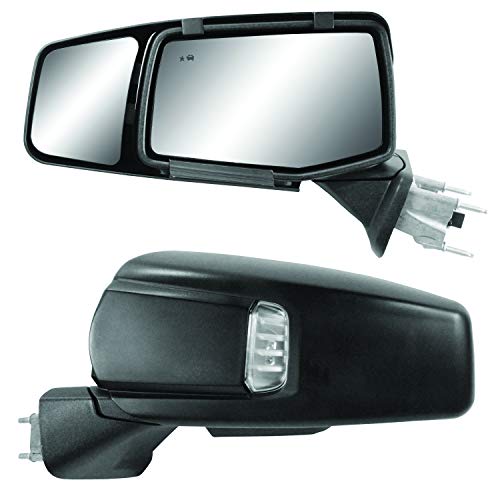
K Source Snap and Zap Custom Fit Towing Mirror for Silverado and Sierra 1500
$65.94A patented snap-on mount molded specifically to fit certain Silverado and Sierra 1500 model years, with an extension that does not interfere with the factory glass and folds along with the original mirror.
Best for: An owner of one of the exact model years this mount is built for, who wants the closest thing to a factory towing mirror without ordering a full replacement.
Check price on AmazonWho should not buy this tier: Any vehicle outside the specific model years this exact mount is molded for. A patented snap-fit mount does not generalize the way a clip-on does, and forcing one onto a different truck is not an option; check the listing fitment years carefully or choose a vehicle-specific slide-over mirror instead.
Do you legally need towing mirrors?
The requirement varies by state rather than following a single federal rule, and it is worth checking your own state DMV or DOT site rather than assuming a number from somewhere else. Commonly the rule is framed around being able to see a set distance behind the vehicle in each mirror, often around 200 feet, once the trailer is wide enough to block the standard mirror view. If the trailer is not wider than the tow vehicle, extended mirrors are frequently not required at all, though they can still be useful for watching the trailer tires in a tight turn.
Clip-on, vehicle-specific or factory-style compared
Only the CIPA 11950 Clip-On Towing Mirror, 15.75 inch covers the existing mirror glass. The vehicle-specific and snap-on options leave the original glass, and any indicator light in it, uncovered.
Published standard A published, traceable figure: a standards body, a federal regulation or a manufacturer specification states it.
| Mirror | Install | Covers factory glass | Price |
|---|---|---|---|
| CIPA 11950 Clip-On Towing Mirror, 15.75 inch | Clip-on, universal, no tools | Yes | $22.42 |
| CIPA 10800 Custom Towing Mirror for Chevrolet, GMC and Cadillac, pair, 18 inch | Slide-over, GM specific | No | $42.97 |
| CIPA 11600 Custom Towing Mirror for Ford and Lincoln, pair, chrome | Slide-over, Ford and Lincoln specific | No | $44.08 |
| CIPA 11500 Custom Towing Mirrors for Ford, pair | Slide-over, Ford specific | No | $68.11 |
| K Source Snap and Zap Custom Fit Towing Mirror for Silverado and Sierra 1500 | Snap-on, molded to specific model years | No | $65.94 |
Confirm your specific model year against the listing fitment before ordering any vehicle-specific mirror. A close model year is not the same as a confirmed fit.
What does a blind spot indicator have to do with a mirror extension?
Many trucks built in the last decade have a small warning light embedded directly in the mirror glass itself, which illuminates when a vehicle is detected in the blind spot. A clip-on extension mounts over that same glass, and depending on the design, it can block the light from view entirely while towing, which is exactly the situation where you most want that warning still working, since a wide trailer already creates a larger blind spot than usual. This is not a defect in the clip-on, it is a direct trade for the lowest price and the fastest install, and a vehicle-specific mirror that clamps around the glass rather than over it is the way to keep the indicator visible.
Before buying anything, look at your own mirror housing with the engine off and the doors unlocked, since the indicator, when a truck has one, is usually a small amber or yellow icon set into the lower outer corner of the glass rather than anywhere on the housing itself. If you cannot find one at all, your mirror likely does not have this feature, and a clip-on carries no real downside beyond the cosmetic look of it sitting over the factory glass.
How we chose
We did not test this hardware in person and we never claim to. Picks are researched from manufacturer specification sheets, published towing standards, and the recurring themes in verified owner reviews. Every pick is matched to a real gross trailer weight rating, a real tongue or pin weight rating, a real receiver size or a real load index rather than to a price bracket, and it is placed in the tier where its published capability actually belongs. We rejected the unbranded flood that dominates the search results in several of these categories, because a weight distribution hitch, a brake controller, a trailer tire and a set of safety chains are all parts whose failure puts a loose trailer on a public road. Where a figure is towing convention rather than a published standard we label it that way, and where a manufacturer does not publish a figure we leave it out instead of estimating it.
Frequently asked questions
Do I legally need extended towing mirrors?
It depends on your state rather than one national rule, generally triggered once the trailer is wider than the tow vehicle and blocks the standard mirror view. Many states phrase the requirement around being able to see a set distance behind the vehicle, often around 200 feet, in each mirror. Check your own state DMV or DOT site rather than assuming a figure from somewhere else.
Does a clip-on mirror block my blind spot warning light?
On many trucks, yes. A growing number of factory mirrors have a blind spot indicator light built into the glass itself, and a clip-on that mounts over that glass can cover the light while towing, which is exactly when you most want it working. A vehicle-specific mirror that clamps around the housing rather than over the glass generally avoids this.
Are vehicle-specific mirrors worth the extra cost over a clip-on?
For anyone towing regularly, generally yes. A vehicle-specific mirror mounts in an engineered position rather than one adjusted by feel, does not obstruct the factory glass or any indicator light in it, and tends to sit more securely at highway speed. A clip-on remains the sensible choice for occasional towing or a vehicle you do not want to commit hardware to.
What if my truck already has factory tow mirrors?
Then none of the mirrors on this page apply to you. Check the owner manual or the door switch panel for a tow mirror extend or fold function before buying anything aftermarket, since a working factory system already solves the same visibility problem these products are built to fix.
Will a clip-on mirror fit any vehicle?
Most clip-on designs use adjustable arms that fit a wide range of mirror shapes and sizes, which is the main appeal over a vehicle-specific mount. Confirm the specific listing states it fits your mirror shape, particularly on trucks with an unusually large or small factory mirror housing, before assuming a universal fit works.
How much extra field of view do I actually need?
Enough to see past both sides of the trailer at its widest point, including the trailer tires in a turn, rather than a fixed number of inches. The practical test is standing at the driver door and confirming you can see the full width of the trailer in each mirror before ever pulling onto the road.
Free download
Get the complete tow rig setups emailed to you
Both ladders, conventional travel trailer and fifth wheel, at beginner, intermediate and expert budgets, every item priced and linked with a running total, plus a printable pre-trip weighing worksheet you can fill in at the scale.
One email with the setups. No sequence, no sharing your address, unsubscribe any time.
Researched, not professional advice. This page is compiled from published standards, manufacturer towing guides and product specifications, and owner-review consensus, not hands-on testing. Figures described as a rule of thumb are towing convention rather than published standards, and they are labelled that way wherever they appear. Nothing here overrides your own ratings. Work your payload sum before your tow rating, because payload is the limit that actually binds on most half ton trucks and nearly every SUV. Load a conventional trailer to 10 to 15 percent tongue weight and a fifth wheel to 15 to 25 percent pin weight, and never lighter: a tail heavy trailer is what starts sway. Weigh the rig loaded rather than trusting a brochure dry weight. A weight distribution hitch and a set of air bags both restore ride height and control, and neither one raises a single rating. Trailer brakes are required by state law above a threshold that varies by state, and a breakaway battery that has quietly gone flat is the normal condition of most trailers on the road.