Coupler locks and hitch pins
Which coupler lock actually fits your trailer, and what will it really stop?
A trailer with a standard coupler and nothing locking it can be taken by anybody who owns a ball mount that fits, in under a minute, with no tools at all. A coupler lock changes that math by blocking the latch mechanism itself, so the coupler cannot close over a ball even if someone backs a hitch right up to it. That is a real and worthwhile improvement over an unlocked trailer.
Be honest about what it actually buys you, because the marketing on this category oversells it constantly. A coupler lock is a deterrent, not a defence. It does not resist a grinder, a hacksaw, or a thief willing to cut the coupler itself, the safety chains or the trailer frame rather than defeat the lock. What it does is move your trailer down the list against a much larger population of opportunists who are looking for the easiest target on a street of parked trailers, and against that group, a visible lock of almost any quality does roughly the same job. A cheap lock and an expensive one both stop the person who is just trying door handles.
The one thing that does matter is fit. Coupler latch mechanisms come in a small number of common sizes, and a lock built for the wrong one either will not physically fit or will not block the latch mechanism completely. Check your coupler before buying based on price or steel thickness, because a lock that does not fit is worse than no lock at all if it gives a false sense of security while sitting unused in a drawer.
On this page
- Beginner: an adjustable lock for a trailer kept somewhere access is already limited
- Intermediate: one lock that fits all three common coupler sizes
- Expert: heavier steel and a keyed-alike two-lock kit for a trailer stored outside
- Be honest about what a coupler lock actually does
- Locks compared by coupler size fit and price
- The other theft nobody plans for
Beginner: an adjustable lock for a trailer kept somewhere access is already limited
For a trailer stored in a garage or a fenced yard most of the time, this tier is a correctly sized deterrent rather than an underpowered one.

Master Lock Adjustable Coupler Lock, stainless steel
$11.88An adjustable stainless steel coupler lock fitting latch widths up to 2-3/4 inches, with a weather touch seal over the keyway, at the lowest price in this category.
Best for: A utility or travel trailer kept in a garage or fenced yard most of the time, where a lock is a deterrent rather than a defence regardless of price.
Check price on AmazonIntermediate: one lock that fits all three common coupler sizes
The value here is not having to confirm a single exact size, which matters if you own more than one trailer or are not entirely sure which coupler size you have.
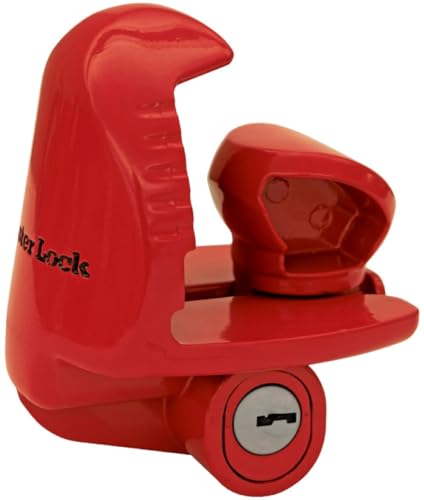
Master Lock Universal Trailer Hitch Lock, fits 1-7/8, 2 and 2-5/16 inch couplers
$32.49Fits 1-7/8, 2 and 2-5/16 inch couplers in one part, in a bright red finish that is itself part of the deterrent, since it is visible from a distance.
Best for: More than one trailer, or any owner not entirely certain which of the three common coupler sizes they have.
Check price on AmazonExpert: heavier steel and a keyed-alike two-lock kit for a trailer stored outside

Rhino USA Trailer Coupler Lock Kit for 2-5/16 inch couplers
$54.90Heavier powder-coated steel sized specifically for a 2-5/16 inch coupler, paired with a matching latch lock on the same key, which covers two separate points of attack with one keyring.
Best for: A travel trailer stored outside for a season, in view of a street, where it is genuinely exposed to more than a passing opportunist.
Check price on AmazonWho should not buy this tier: A trailer locked inside a garage or a fenced yard most of the year. The heavier steel and the keyed-alike two-lock kit here solve the problem of a trailer visible from the street; paying for that protection on a trailer nobody can casually walk up to is money spent on a threat that is not actually present.
Be honest about what a coupler lock actually does
A coupler lock does not defend against a determined thief with a grinder, a hacksaw, or a truck and a spare ball mount of their own, because the coupler itself, the safety chains and the trailer frame remain vulnerable to being cut regardless of what is locking the latch. What a visible lock reliably does is move your trailer down the list against a much larger and much lazier population of people looking for the easiest available target on a street of parked trailers, and against that group a $12 lock and a $55 lock work about the same. Buy based on fit and on how exposed the trailer actually is, not on the idea that heavier steel defeats a serious thief.
Locks compared by coupler size fit and price
The Master Lock Universal Trailer Hitch Lock, fits 1-7/8, 2 and 2-5/16 inch couplers and Master Lock Trailer Tongue Lock both fit all three common sizes, while the Rhino USA Trailer Coupler Lock Kit for 2-5/16 inch couplers is sized specifically for 2-5/16 inch couplers only.
Published standard A published, traceable figure: a standards body, a federal regulation or a manufacturer specification states it.
| Lock | Coupler sizes it fits | Material | Price |
|---|---|---|---|
| Master Lock Adjustable Coupler Lock, stainless steel | Adjustable up to 2-3/4 in latch width | Stainless steel | $11.88 |
| Master Lock Universal Trailer Hitch Lock, fits 1-7/8, 2 and 2-5/16 inch couplers | 1-7/8, 2 and 2-5/16 in | Steel | $32.49 |
| Master Lock Trailer Tongue Lock | 1-7/8, 2 and most 2-5/16 in | Zinc | $35.99 |
| Rhino USA Trailer Coupler Lock Kit for 2-5/16 inch couplers | 2-5/16 in specifically | Heavy powder-coated steel | $54.90 |
Confirm the size stamped on your own coupler before ordering. A lock sized for the wrong coupler either will not fit or will not fully block the latch mechanism.
The other theft nobody plans for
Every lock above protects the coupler on a parked trailer. It does nothing for an expensive adjustable ball mount left sitting in a truck receiver overnight, which is a separate and genuinely common theft. A locking receiver pin closes that gap for a completely different part of the rig, and it is worth owning alongside whichever coupler lock you buy rather than instead of it.

Rhino USA Locking Receiver Pin, 2 inch hitch
$25.90Locks the ball mount into the receiver, which is the theft nobody plans for: a $300 adjustable mount left in the receiver overnight.
Best for: Anybody leaving an expensive ball mount in the truck.
Check price on AmazonHow we chose
We did not test this hardware in person and we never claim to. Picks are researched from manufacturer specification sheets, published towing standards, and the recurring themes in verified owner reviews. Every pick is matched to a real gross trailer weight rating, a real tongue or pin weight rating, a real receiver size or a real load index rather than to a price bracket, and it is placed in the tier where its published capability actually belongs. We rejected the unbranded flood that dominates the search results in several of these categories, because a weight distribution hitch, a brake controller, a trailer tire and a set of safety chains are all parts whose failure puts a loose trailer on a public road. Where a figure is towing convention rather than a published standard we label it that way, and where a manufacturer does not publish a figure we leave it out instead of estimating it.
Frequently asked questions
Will a coupler lock actually stop a determined thief?
No, and no lock in this category claims to. A determined thief with a grinder or a hacksaw can cut the lock, the coupler, the safety chains or the frame regardless of what is installed. A coupler lock deters the much larger population of opportunists looking for an easy, unlocked target, and against that group it works well. Treat it as a deterrent rather than a defence.
What size coupler lock do I need?
Check the size stamped on your coupler, commonly 1-7/8, 2 or 2-5/16 inches, and match a lock built for that exact size or an adjustable or universal lock that explicitly covers it. A lock sized for the wrong coupler will either fail to fit or leave part of the latch mechanism exposed, which defeats the purpose of installing one.
Should I lock the coupler, the receiver pin, or both?
Both, if the trailer or the tow vehicle is left unattended with hardware attached. A coupler lock protects a parked trailer from being coupled to. A locking receiver pin protects an expensive ball mount left in the truck receiver from being lifted out. They guard two different pieces of hardware and neither one covers the other.
Does a heavier steel lock actually deter theft better than a cheap one?
Against a casual opportunist, not meaningfully. Most theft in this category is a crime of convenience, and a visible lock of almost any build quality moves a trailer down the list of easy targets equally well. Heavier steel matters more against someone specifically targeting your trailer with cutting tools, which is a different and much rarer threat.
Can I use one coupler lock on more than one trailer?
Yes, as long as the lock's size matches every coupler you intend to use it on. A universal lock covering 1-7/8, 2 and 2-5/16 inch couplers, such as the Master Lock Universal, is the practical choice for anyone who owns more than one trailer with different coupler sizes, since a size-specific lock only ever fits one of them.
Does locking the coupler replace insurance or a GPS tracker?
No. A coupler lock is a physical deterrent at the point of theft and nothing else. It has no bearing on recovering a stolen trailer after the fact, which is what a GPS tracker addresses, or on covering the financial loss, which is what insurance is for. The three serve different purposes and none substitutes for the others.
Free download
Get the complete tow rig setups emailed to you
Both ladders, conventional travel trailer and fifth wheel, at beginner, intermediate and expert budgets, every item priced and linked with a running total, plus a printable pre-trip weighing worksheet you can fill in at the scale.
One email with the setups. No sequence, no sharing your address, unsubscribe any time.
Researched, not professional advice. This page is compiled from published standards, manufacturer towing guides and product specifications, and owner-review consensus, not hands-on testing. Figures described as a rule of thumb are towing convention rather than published standards, and they are labelled that way wherever they appear. Nothing here overrides your own ratings. Work your payload sum before your tow rating, because payload is the limit that actually binds on most half ton trucks and nearly every SUV. Load a conventional trailer to 10 to 15 percent tongue weight and a fifth wheel to 15 to 25 percent pin weight, and never lighter: a tail heavy trailer is what starts sway. Weigh the rig loaded rather than trusting a brochure dry weight. A weight distribution hitch and a set of air bags both restore ride height and control, and neither one raises a single rating. Trailer brakes are required by state law above a threshold that varies by state, and a breakaway battery that has quietly gone flat is the normal condition of most trailers on the road.