Weight distribution
Weight distribution hitch or a standard ball mount: which does your trailer need?

CURT 17063 Round Bar Weight Distribution Hitch with Sway Control, 14,000 lb
$366.88 Published ratingsA complete kit with spring bars and a friction sway bar, built to move tongue load off the rear axle and onto the steer axle and trailer axles.
Best for: A large travel trailer where you want a complete kit at a mid range price.
Check price on Amazon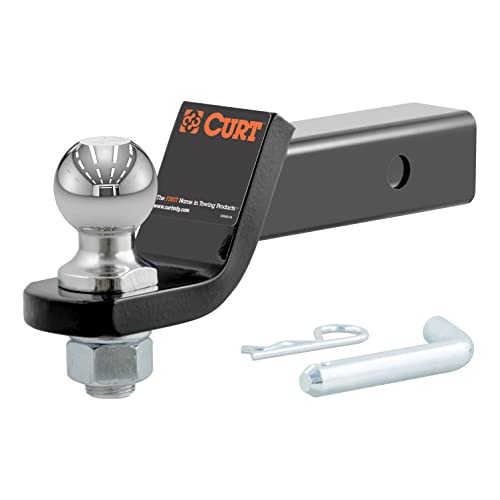
CURT 45036 Loaded Ball Mount, 7,500 lb, 2 inch drop
$31.99A fixed head with the ball pre-installed and torqued. It holds the trailer at the right height and does nothing else.
Best for: Somebody who does not own a torque wrench big enough for a ball nut.
Check price on AmazonA weight distribution hitch wins for any trailer where tongue weight is doing real damage to the tow vehicle: a nose-high stance, a wandering steer wheel, headlights aimed at the treetops instead of the road. A standard ball mount wins for anything light enough that none of that happens, because it is cheaper, lighter, and has nothing to disconnect before backing into a site.
The mechanical difference is simple. A standard ball mount is a bar with a ball on it, so whatever tongue weight the trailer produces sits entirely on the tow vehicle rear axle. A weight distribution hitch adds spring bars, or in the Andersen design a pair of tension chains, that lever some of that load forward onto the steer axle and back onto the trailer's own axles. The trailer and tow vehicle both level out, and steering feel, braking and headlight aim all come back.
Neither part changes what the vehicle is rated to carry. That is the piece people get backwards most often, and it matters more than which of these two you buy.
When does a standard ball mount stop being enough?
There is no single number that governs every rig, but towing convention gives a working set of triggers. Any one of them is reason enough to move up.
Weight distribution is conventionally called for once a trailer passes roughly 5,000 lb or its tongue weight exceeds about 10 percent of the tow vehicle weight.
Rule of thumb Widely taught towing convention rather than a published specification. It is a good starting point and it is not a rating.
| Trigger | Threshold | Why it matters |
|---|---|---|
| Trailer weight | above about 5,000 lb | Tongue weight at this size is enough to noticeably lift the tow vehicle steer axle. |
| Tongue weight vs tow vehicle weight | above about 10 percent | A lighter tow vehicle can be pushed into a nose-high stance by a trailer many trucks would barely notice. |
| Visible squat at hitch-up | any amount | If the rear bumper visibly drops and the headlights aim high, distribute the load regardless of what the trailer weighs on paper. |
| Wandering or light steering on the road | any amount | This is the steer axle telling you it has lost weight to the rear axle. A ball mount cannot fix it. |
These are towing conventions taught by hitch makers and towing schools, not a single published regulation. Your receiver rating and your door jamb payload sticker are the hard limits either way.
What does a weight distribution hitch actually change?
A weight distribution hitch moves load between axles. It does not raise payload, it does not raise GVWR, it does not raise GCWR, and it does not raise any axle rating. A truck that sits level with a weight distribution hitch installed is carrying exactly the same total weight it was carrying nose-down on a standard ball mount, just spread differently across the axles it already has.
What changes is where that weight sits. On a plain ball mount, tongue weight presses down on the ball, which levers the tow vehicle rear axle down and the steer axle up. Add spring bars under tension and some of that same weight is redirected forward, through the hitch head and the frame, onto the steer axle, and rearward, through the trailer frame, onto the trailer's own axles. The rear axle stops carrying all of it alone. Steering weight, braking balance and headlight aim all improve because the axle they depend on is no longer light.
Some hitches also add sway control, either built into the head or bolted on beside it. A standard ball mount has none, and cannot accept an add-on sway bar either, since there is no weight distribution hardware for the bar to attach to.
Side by side
A weight distribution hitch adds hardware and setup time; a standard ball mount adds neither, and simply is not built to correct a heavy tongue.
Rule of thumb Widely taught towing convention rather than a published specification. It is a good starting point and it is not a rating.
| Standard ball mount | Weight distribution hitch | |
|---|---|---|
| What it does | Holds the ball at a fixed height, nothing else | Moves tongue load onto the steer axle and trailer axles |
| Sway control available | No, and none can be added to it | Built in on some models, bolt-on available on others |
| Setup time at each hitch-up | Seconds | A few minutes to seat bars and check tension |
| Weight of the head assembly | A few pounds | Commonly 40 to 80 lb with bars attached |
| Raises payload or GVWR | No | No |
Neither part touches a rating printed by the vehicle or trailer manufacturer. Both are limited by whichever rating on the rig is lowest.
Can a standard ball mount ever replace a weight distribution hitch you actually need?
No. A ball mount has no mechanism for moving load anywhere. If the rig needs distribution and gets a plain ball mount instead, the rear axle carries the full tongue weight regardless of how the tow vehicle owner's manual describes the trailer as light. The visible symptoms, a nose-high tow vehicle and vague steering, are the vehicle telling you the truth about what is happening at the axle even when the trailer weight alone looks modest on paper.
The reverse mistake is rarer but real: putting a weight distribution hitch on a trailer light enough that a ball mount was doing the job fine. That is not dangerous, it is just unnecessary weight and setup time, and it will not hurt anything to leave it in place if you already own one.
Frequently asked questions
Does a weight distribution hitch increase my towing capacity?
No. A weight distribution hitch moves load between axles and does not raise payload, GVWR, GCWR or any axle rating. Some receivers publish a separate, higher weight-distributing rating, and that number belongs to the receiver rather than to the hitch bolted into it. Your door jamb sticker and owner's manual govern everything regardless of which hitch is installed.
When is a standard ball mount actually safe to use?
A standard ball mount is fine for a light trailer, conventionally under about 5,000 lb, where the tongue weight does not visibly squat the tow vehicle or lighten the steering. Utility trailers, small cargo trailers and many boat trailers fall into this range. The tell is the rig itself: if it sits level and steers normally on the ball mount, distribution is not solving a problem you have.
Can I start with a ball mount and add weight distribution later?
Yes, and it is a common upgrade path. A ball mount is replaced entirely by a weight distribution hitch head rather than modified, since the whole point is the spring bars and the frame brackets the ball mount never had. Nothing about starting with a ball mount locks you out of adding distribution once the trailer, or the loading, calls for it.
Does a weight distribution hitch replace the ball mount, or work alongside it?
It replaces it. A weight distribution hitch head has its own ball, shank and bracket system built around the spring bars, so the ball mount comes off the receiver and the weight distribution head goes on in its place. You end up with one part doing the job, not two parts stacked together.
Is it legal to tow a heavy trailer on a standard ball mount?
Legality depends on staying within your receiver rating, your vehicle's GVWR and GCWR, and your state's requirements, none of which a ball mount enforces on its own. A trailer within every published rating can legally ride on a plain ball mount even if it tows badly. The unsafe outcome is sway and poor steering, not a specific legal line, which is why the conventional 5,000 lb and 10 percent triggers exist.
What tongue weight percentage tells me I need distribution?
Once tongue weight climbs past roughly 10 percent of the tow vehicle's own weight, distribution is conventionally called for, and that trigger can arrive at a lower trailer weight behind a lighter SUV than behind a heavy truck. Weigh the tongue with the trailer loaded the way you actually travel, not from a brochure figure, before deciding either way.
Free download
Get the complete tow rig setups emailed to you
Both ladders, conventional travel trailer and fifth wheel, at beginner, intermediate and expert budgets, every item priced and linked with a running total, plus a printable pre-trip weighing worksheet you can fill in at the scale.
One email with the setups. No sequence, no sharing your address, unsubscribe any time.
Researched, not professional advice. This page is compiled from published standards, manufacturer towing guides and product specifications, and owner-review consensus, not hands-on testing. Figures described as a rule of thumb are towing convention rather than published standards, and they are labelled that way wherever they appear. Nothing here overrides your own ratings. Work your payload sum before your tow rating, because payload is the limit that actually binds on most half ton trucks and nearly every SUV. Load a conventional trailer to 10 to 15 percent tongue weight and a fifth wheel to 15 to 25 percent pin weight, and never lighter: a tail heavy trailer is what starts sway. Weigh the rig loaded rather than trusting a brochure dry weight. A weight distribution hitch and a set of air bags both restore ride height and control, and neither one raises a single rating. Trailer brakes are required by state law above a threshold that varies by state, and a breakaway battery that has quietly gone flat is the normal condition of most trailers on the road.