Wheel chocks and stabilisers
Which wheel chock or stabiliser does your trailer actually need?
Two genuinely different products get shopped for in the same search and only one of them belongs on every trailer. A wheel chock stops the trailer from rolling. It sits against a tire, front or back depending on the slope, and it does the same job on a single axle utility trailer that it does on a triple axle fifth wheel. Every trailer needs this, full stop, before it is ever unhitched.
A tandem axle stabiliser is a completely different product that happens to look similar and sits near it on a shelf. Rather than stopping the trailer rolling, it expands to wedge between the two tires on the same side of a tandem or triple axle, locking them against each other. That removes the fore-and-aft rock that makes a parked trailer feel like it is moving every time somebody walks across the floor inside it, which a plain chock does nothing about because a chock only touches one tire.
Here is the part that actually matters before you buy one: a stabiliser only works where there are two tires on the same side to wedge between. On a single axle trailer there is exactly one tire per side, with nothing behind or ahead of it to brace against, so a stabiliser sold for this purpose is simply the wrong product there. If your trailer has one axle, buy chocks and stop. If it has two or three, a stabiliser is a real and noticeable upgrade on top of the chocks you still need.
On this page
- Beginner: chocks that stop a trailer rolling, on any axle count
- Intermediate: solid rubber for gravel, grass and wet sites
- Expert: the tandem axle stabiliser that removes a rock no chock can touch
- Chocks and stabilisers are two different products, not one
- How many chocks does a tandem axle trailer actually need?
- Chocks and stabilisers compared by material and price
Beginner: chocks that stop a trailer rolling, on any axle count
This is the baseline every trailer needs, single axle or triple, before anything else on this page is even worth considering.

Camco RV Wheel Chocks with Rope, 2 pack
$17.18Plastic chocks with a pull rope so they can be retrieved without crawling under the trailer, sized for tires up to 26 inches and made in the United States.
Best for: Basic chocking on a reasonably level site, on a single axle or a multi axle trailer alike.
Check price on AmazonIntermediate: solid rubber for gravel, grass and wet sites
The upgrade here is grip rather than a different function. Solid rubber holds on a surface where a lighter plastic chock can slide before it ever does its job.
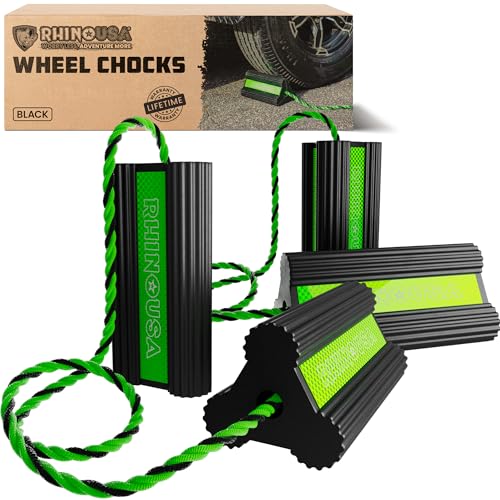
Rhino USA Heavy Duty Rubber Wheel Chocks
$54.90Solid rubber with a tri-point non-slip design and reflective striping for visibility at a dark campsite, backed by a lifetime guarantee.
Best for: A heavier trailer parked on gravel, grass or a wet site where a plastic chock is more likely to slip.
Check price on AmazonExpert: the tandem axle stabiliser that removes a rock no chock can touch
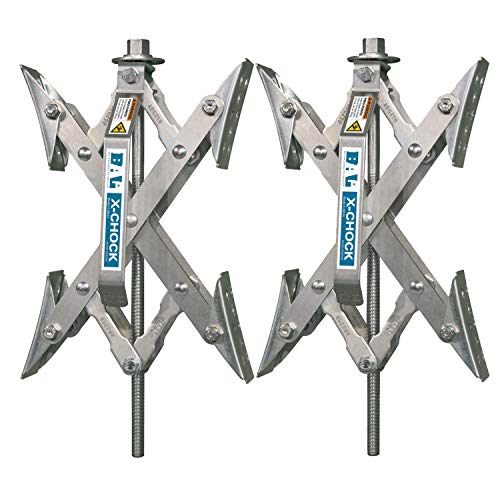
BAL X-Chock Tire Locking Chock, pair
$74.51Expands between the two tires of a tandem axle and locks them against each other with a ratchet mechanism, removing the fore and aft rock that makes a parked trailer feel like it is moving.
Check before buying: It only works on a tandem or triple axle. On a single axle trailer there is no second tire to wedge against and this is the wrong product.
Best for: Any tandem or triple axle travel trailer or fifth wheel, used in addition to plain chocks rather than instead of them.
Check price on AmazonWho should not buy this tier: Any single axle trailer. There is no second tire on that axle to wedge against, so a stabiliser genuinely does nothing there regardless of how it is marketed. Buy plain chocks for a single axle trailer and stop; this specific product only earns its price on a tandem or triple axle, where it is bracing between two real tires.
Chocks and stabilisers are two different products, not one
A wheel chock stops the trailer rolling on any axle count. An X-chock stabiliser stops the trailer rocking, and only where two tires exist to wedge between.
Rule of thumb Widely taught towing convention rather than a published specification. It is a good starting point and it is not a rating.
| Product | What it stops | Works on a single axle trailer | Works on a tandem or triple axle trailer |
|---|---|---|---|
| Wheel chock | The trailer rolling away from a parked position | Yes | Yes, at least one per wheel end |
| Tandem axle stabiliser (X-chock) | Fore and aft rock felt inside the trailer | No, there is no second tire to wedge against | Yes, one pair per side |
This distinction is widely understood among experienced owners rather than published by any single standards body, and it is the single most common mix-up in this product category.
How many chocks does a tandem axle trailer actually need?
At minimum, one chock against the downhill-facing side of one tire, which is enough to satisfy the basic job of preventing a roll on level ground. In practice, most experienced owners chock both the front and back of a tire on at least one wheel, and some chock a wheel on each side of the trailer, because a site that looks level rarely is once weight starts shifting inside during unloading. If you are also installing a tandem axle stabiliser such as the BAL X-Chock Tire Locking Chock, pair, that goes on in addition to the chocks, not instead of them; it stops rocking, and chocks are still what stop an actual roll if the trailer is ever unhitched on a slope.
Chocks and stabilisers compared by material and price
Plain chocks range from $15.99 to $54.90, while the BAL X-Chock Tire Locking Chock, pair at $74.51 is the only stabiliser here and needs a tandem or triple axle to work at all.
Published standard A published, traceable figure: a standards body, a federal regulation or a manufacturer specification states it.
| Product | Function | Material | Price |
|---|---|---|---|
| Camco RV Wheel Chocks with Rope, 2 pack | Stops rolling | Plastic | $17.18 |
| MaxxHaul Solid Rubber Wheel Chock, 2 pack | Stops rolling | Solid rubber | $15.99 |
| Rhino USA Heavy Duty Rubber Wheel Chocks | Stops rolling | Solid rubber | $54.90 |
| BAL X-Chock Tire Locking Chock, pair | Stops rocking between two tires | Zinc-coated steel | $74.51 |
Weight capacity for plain chocks is generally published as a tire diameter fit rather than a load rating. Read the specific listing for the maximum tire diameter it is built for.
How we chose
We did not test this hardware in person and we never claim to. Picks are researched from manufacturer specification sheets, published towing standards, and the recurring themes in verified owner reviews. Every pick is matched to a real gross trailer weight rating, a real tongue or pin weight rating, a real receiver size or a real load index rather than to a price bracket, and it is placed in the tier where its published capability actually belongs. We rejected the unbranded flood that dominates the search results in several of these categories, because a weight distribution hitch, a brake controller, a trailer tire and a set of safety chains are all parts whose failure puts a loose trailer on a public road. Where a figure is towing convention rather than a published standard we label it that way, and where a manufacturer does not publish a figure we leave it out instead of estimating it.
Frequently asked questions
Do I need an X-chock stabiliser on a single axle trailer?
No, and buying one for a single axle trailer wastes the money entirely. An X-chock stabiliser works by expanding between the two tires on the same side of a tandem or triple axle, and a single axle trailer has only one tire per side with nothing to wedge against. Use plain wheel chocks on a single axle trailer instead, which is the product it actually needs.
What is the actual difference between a wheel chock and a tandem axle stabiliser?
A wheel chock sits against one tire and stops the trailer from rolling, which every trailer needs regardless of axle count. A tandem axle stabiliser expands between the two tires on one side of a tandem or triple axle and locks them together, removing the fore and aft rock felt inside the trailer. They solve different problems and most tandem axle owners eventually want both.
How many wheel chocks do I need on a tandem axle trailer?
At minimum one, placed against the downhill side of a tire on level ground, but most experienced owners chock both directions on at least one wheel because sites that look level often are not once weight shifts during unloading. Chocking is separate from and in addition to any tandem axle stabiliser installed on the same trailer.
Do rubber chocks work better than plastic ones?
On gravel, grass or a wet site, generally yes, because solid rubber grips better than lighter plastic and is less likely to slide before it stops the trailer. On dry pavement the difference matters less. Rubber chocks also tend to be heavier and more resistant to UV cracking over years of outdoor storage.
Should I still use wheel chocks if my trailer has an X-chock installed?
Yes, always. An X-chock stabiliser removes rocking between two tires on a tandem axle, but it does not perform the job of a wheel chock, which is stopping an actual roll if the trailer becomes unhitched or the parking surface is not as level as it looked. The two products are complementary, not substitutes for each other.
Can wheel chocks replace the trailer's stabiliser jacks at the corners?
No. Corner stabiliser jacks are there to reduce bounce and sway while walking around inside a parked trailer by contacting the ground at the frame corners, and they are not rated to support the trailer's actual weight the way axle jacks or a jack stand would be. Wheel chocks address rolling, corner jacks address bounce, and neither is a substitute for the other.
Free download
Get the complete tow rig setups emailed to you
Both ladders, conventional travel trailer and fifth wheel, at beginner, intermediate and expert budgets, every item priced and linked with a running total, plus a printable pre-trip weighing worksheet you can fill in at the scale.
One email with the setups. No sequence, no sharing your address, unsubscribe any time.
Researched, not professional advice. This page is compiled from published standards, manufacturer towing guides and product specifications, and owner-review consensus, not hands-on testing. Figures described as a rule of thumb are towing convention rather than published standards, and they are labelled that way wherever they appear. Nothing here overrides your own ratings. Work your payload sum before your tow rating, because payload is the limit that actually binds on most half ton trucks and nearly every SUV. Load a conventional trailer to 10 to 15 percent tongue weight and a fifth wheel to 15 to 25 percent pin weight, and never lighter: a tail heavy trailer is what starts sway. Weigh the rig loaded rather than trusting a brochure dry weight. A weight distribution hitch and a set of air bags both restore ride height and control, and neither one raises a single rating. Trailer brakes are required by state law above a threshold that varies by state, and a breakaway battery that has quietly gone flat is the normal condition of most trailers on the road.