Running costs
What will the fuel cost while towing?
This is a consumer trip calculation. It is not cost per mile, it is not a business expense model, and it is not an owner-operator economics tool. Those are commercial trucking calculations and they live on our sister site rather than here.
What matters for a trip budget is the gap between towing and not towing, because that gap is the real cost of the trailer. Enter your own observed figures if you have them: a trip computer average over a previous towing trip beats any estimate.
Estimate the trip
The trailer costs $150.46 extra on this trip, a 44.1% fuel economy penalty.
| Figure | Value |
|---|---|
| Gallons while towing | 94.7 |
| Cost while towing | $341.05 |
| Cost for the same trip unhitched | $190.59 |
| Extra cost of bringing the trailer | $150.46 |
| Towing penalty | 44.1% |
Shown with the example figures above. Change any field to run your own numbers.
The working
Published standardgallons towing = miles / mpg towing cost towing = gallons towing x price per gallon the towing penalty = 1 - (mpg towing / mpg unhitched)
Plain arithmetic. The mpg figures are yours to observe rather than ours to supply. A published, traceable figure: a standards body, a federal regulation or a manufacturer specification states it.
The cheapest economy upgrade is correct tire pressure
Underinflated trailer tires add rolling resistance as well as heat, and heat is what destroys them. A gauge that reads past 60 psi and a monitor that watches while you drive are worth more than any fuel additive.

Tymate TM2 RV Tire Pressure Monitoring System, 4 sensors
$69.99The step up in the same range, with a larger and clearer display.
Best for: A tandem axle trailer where the entry display is hard to read in sun.
Check price on Amazon
Explore Land Tire Covers, 4 pack, fits 26 to 28.75 inch diameters
$48.99Trailer tires age out from ultraviolet exposure long before the tread wears, and a trailer spends most of its life parked. Covers are the cheapest thing on this site that extends the life of the most expensive consumable on the trailer.
Best for: Any trailer that is stored outdoors between trips.
Check price on Amazon
Tymate TM7 RV Tire Pressure Monitoring System, 4 sensors
$44.99Four sensors and a solar charged display, which covers a tandem axle trailer. The cheapest credible entry into monitoring, and monitoring at all beats monitoring perfectly.
Best for: A tandem axle travel trailer.
Check price on Amazon Explore Land Tire Covers, 4 pack, fits 23 to 25.75 inch diameters
$38.99The smaller diameter set, for 14 and 15 inch trailer wheels.
Best for: A smaller trailer stored outside.
Check price on Amazon
JACO ElitePro Digital Tire Pressure Gauge, 200 psi
$29.90Reads to 200 psi, which comfortably covers an 80 psi load range E trailer tire where a 60 psi car gauge simply cannot.
Best for: Any trailer with load range D or E tires.
Check price on Amazon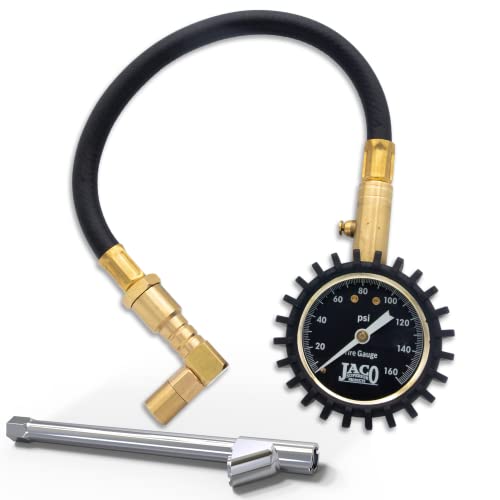
JACO EliteProPlus Tire Pressure Gauge with Dually Air Chuck, 160 psi
$25.90The dually chuck reaches the inner valve stem on a dual rear wheel truck, which a standard chuck cannot get to at all.
Best for: A dually tow vehicle.
Check price on AmazonEvery rating shown is the manufacturer's own published figure. The rating on the part you receive is what governs, and your own door jamb sticker governs everything above it.
Why weight matters less than you think
Once you are at highway speed on level ground, most of the fuel is going into pushing air out of the way, and aerodynamic drag scales with frontal area and with the square of speed. A tall slab sided travel trailer has an enormous frontal area and a shape nobody optimised, which is why the penalty is so large.
Weight dominates in two other places: climbing, where you are lifting the whole rig against gravity, and accelerating, where you are adding kinetic energy you then throw away at the next stop. On a flat interstate cruise it is mostly air.
The practical consequence: slowing down saves more fuel than lightening the load, on the flat. Dropping from 70 to 60 mph is a bigger change than almost anything you could take out of the trailer.
Typical towing penalties
These are observed ranges rather than published figures, and yours will differ. Use them only to sanity check a number you entered.
A tall travel trailer commonly costs 30 to 50 percent of unhitched fuel economy, and a low flat trailer much less.
Rule of thumb Widely taught towing convention rather than a published specification. It is a good starting point and it is not a rating.
| What you are pulling | Typical penalty against unhitched |
|---|---|
| A low flat utility or boat trailer | 10 to 25 percent |
| A small or teardrop camper | 15 to 30 percent |
| A tall travel trailer | 30 to 50 percent |
| A large fifth wheel or toy hauler | 40 to 55 percent |
Observed owner ranges, not manufacturer figures. Headwinds, grades and speed move them a long way, and a crosswind costs far more than a still day.
Cheap ways to reduce it
- Slow down. The single biggest lever on the flat, and it also keeps you inside the speed rating of most ST trailer tires.
- Correct tire pressure. Underinflated trailer tires add rolling resistance as well as heat, and heat is what destroys them.
- Travel with empty fresh tanks where you can fill on arrival. Fifty gallons is 417 lb you are hauling over a mountain pass for no reason.
- Tow in tow/haul mode. It changes shift points to keep the transmission out of a hunting cycle, which helps economy and helps the transmission far more.
Frequently asked questions
How much does towing hurt fuel economy?
Commonly 30 to 50 percent of the unhitched figure for a tall travel trailer, less for a low flat trailer and more for a large fifth wheel. The dominant factor at highway speed is frontal area rather than weight, because aerodynamic drag scales with area and with the square of speed. Your own trip computer average from a previous towing trip is far better than any estimate.
Does weight or aerodynamics matter more?
Aerodynamics, once you are at highway speed on level ground, because most of the fuel is going into pushing air out of the way. Weight dominates when climbing, where you are lifting the rig against gravity, and when accelerating. On a flat interstate cruise, slowing down saves more fuel than lightening the load.
Will slowing down actually save much?
Yes, more than almost anything else on the flat. Drag rises with the square of speed, so dropping from 70 to 60 mph is a large reduction in the work being done. It also keeps you inside the industry speed rating of most ST trailer tires, which is 65 mph unless the sidewall says otherwise, so it is a safety gain as well.
Does travelling with empty water tanks help?
It helps with climbing and acceleration rather than with flat cruising, and it helps a great deal with your cargo capacity and tongue weight. Water is 8.34 lb per gallon, so a 50 gallon tank is 417 lb. If you can fill at the campground, that is weight you are not hauling over a mountain pass for no reason.
Is this the same as cost per mile?
No. Cost per mile is a commercial owner-operator calculation that includes fixed costs, maintenance reserves, insurance, depreciation and the tax treatment of all of it. This is a consumer trip fuel estimate and nothing more. The commercial calculation lives on our sister site rather than here, because the two audiences need genuinely different tools.
Why is the difference more useful than the total?
Because the difference is the actual cost of bringing the trailer. The total includes fuel you would have burned driving there anyway, so it overstates what the trailer costs you and makes two trips of different lengths hard to compare. The penalty figure is what tells you whether a shorter route or a slower speed is worth it.
Free download
Get the complete tow rig setups emailed to you
Both ladders, conventional travel trailer and fifth wheel, at beginner, intermediate and expert budgets, every item priced and linked with a running total, plus a printable pre-trip weighing worksheet you can fill in at the scale.
One email with the setups. No sequence, no sharing your address, unsubscribe any time.
Researched, not professional advice. This page is compiled from published standards, manufacturer towing guides and product specifications, and owner-review consensus, not hands-on testing. Figures described as a rule of thumb are towing convention rather than published standards, and they are labelled that way wherever they appear. Nothing here overrides your own ratings. Work your payload sum before your tow rating, because payload is the limit that actually binds on most half ton trucks and nearly every SUV. Load a conventional trailer to 10 to 15 percent tongue weight and a fifth wheel to 15 to 25 percent pin weight, and never lighter: a tail heavy trailer is what starts sway. Weigh the rig loaded rather than trusting a brochure dry weight. A weight distribution hitch and a set of air bags both restore ride height and control, and neither one raises a single rating. Trailer brakes are required by state law above a threshold that varies by state, and a breakaway battery that has quietly gone flat is the normal condition of most trailers on the road.