Trailers with a 3,000 lb dry weight
How much can you actually load in a 3,000 lb dry weight trailer?
Dry weight, or unloaded vehicle weight, is the trailer as it left the factory. It is the number in the brochure and it is the number nobody ever tows at. It does not include dealer-installed options, and that is where buyers get caught: a second air conditioner, a solar package, an awning upgrade and a generator prep can take several hundred pounds out of the cargo capacity the brochure advertised.
The figure that matters is on the yellow or white cargo carrying capacity label on the trailer itself, and it is the authority. What this page gives you is the arithmetic behind it, so you can see where the capacity goes before you buy a trailer rather than after.
Water is the biggest single variable and it surprises people every time. Water weighs 8.34 lb per gallon, so a 26 gallon fresh tank is 217 lb full. On a half ton friendly trailer that is frequently most of the cargo capacity in one tank.
The formula
Cargo carrying capacity
Published standardCCC = GVWR - UVW - full fresh water - full propane - batteries water = (fresh gallons + water heater gallons) x 8.34 lb propane = cylinders x about 37 lb for a 20 lb bottle, full battery = about 50 lb for a group 24 lead acid
A full 20 lb propane cylinder weighs about 37 lb because the steel bottle itself is around 17 lb. People count the propane and forget the bottle.
The gap between GVWR and dry weight is what you are really buying, and trailers with identical dry weights can differ by a thousand pounds in that gap. Here is what each gap produces on a 3,000 lb trailer.
With a 5,000 lb GVWR, a 3,000 lb dry weight trailer has about 1,609 lb of cargo capacity once a 26 gallon fresh tank, two propane cylinders and a battery are counted.
Published standard A published, traceable figure: a standards body, a federal regulation or a manufacturer specification states it.
| GVWR | Gap over dry weight | Fluids and batteries | Left for cargo |
|---|---|---|---|
| 4,000 lb | 1,000 lb | 391 lb | 609 lb |
| 4,500 lb | 1,500 lb | 391 lb | 1,109 lb |
| 5,000 lb | 2,000 lb | 391 lb | 1,609 lb |
| 5,500 lb | 2,500 lb | 391 lb | 2,109 lb |
| 6,000 lb | 3,000 lb | 391 lb | 2,609 lb |
Your own trailer certification label states its GVWR and its cargo carrying capacity directly. Use those, not this table, for your trailer.
What does the fresh water tank cost you?
This is the single most useful trade on the whole trailer, because it is the one you can change at the dump station five minutes before you leave. Travelling with empty tanks and filling on arrival converts water weight straight back into cargo capacity.
Water weighs 8.34 lb per gallon, so a 26 gallon tank is 217 lb and a 100 gallon tank is 834 lb.
Published standard A published, traceable figure: a standards body, a federal regulation or a manufacturer specification states it.
| Fresh tank size | Full weight | Cargo left on a 5,000 lb GVWR |
|---|---|---|
| 20 gal | 167 lb | 1,709 lb |
| 26 gal | 217 lb | 1,659 lb |
| 30 gal | 250 lb | 1,626 lb |
| 36 gal | 300 lb | 1,576 lb |
| 40 gal | 334 lb | 1,542 lb |
| 44 gal | 367 lb | 1,509 lb |
| 50 gal | 417 lb | 1,459 lb |
| 60 gal | 500 lb | 1,376 lb |
| 66 gal | 550 lb | 1,326 lb |
| 80 gal | 667 lb | 1,209 lb |
| 100 gal | 834 lb | 1,042 lb |
Grey and black tanks matter on the way home rather than on the way out, and a full black tank weighs the same as a full fresh tank of the same size.
Where the capacity actually goes
People assume cargo capacity is consumed by luggage. It is mostly consumed by things that live in the trailer permanently or arrive with it. A realistic list on a trailer of this size:
- Water, 217 lb with a 26 gallon tank full
- Propane, about 74 lb for two full 20 lb cylinders including the bottles
- Batteries, 50 lb for one group 24, double that for two, or about 30 lb for a 100 Ah lithium
- Dealer-installed options, which are not in the brochure dry weight at all
- Bedding, dishes, tools, chairs, a grill, a generator, which is the part everybody does count
And it goes the other way too: the tongue weight this trailer produces is a percentage of the LOADED weight, so every pound you add to the trailer adds roughly a tenth of a pound to your tow vehicle payload as well.
Gear for weighing and levelling this trailer
Chosen against the numbers on this page rather than from a general list, so the recommendation cannot contradict the arithmetic above. Every rating quoted is the manufacturer figure, and the rating on the part you receive is what governs.

Sherline LM 2000 Trailer Tongue Weight Scale, 2,000 lb
$189.90Double the capacity for the same money as the LM 1000, which makes it the sensible default unless you are certain your tongue weight is low.
Best for: Most travel trailers, with headroom for a heavier one later.
Check price on Amazon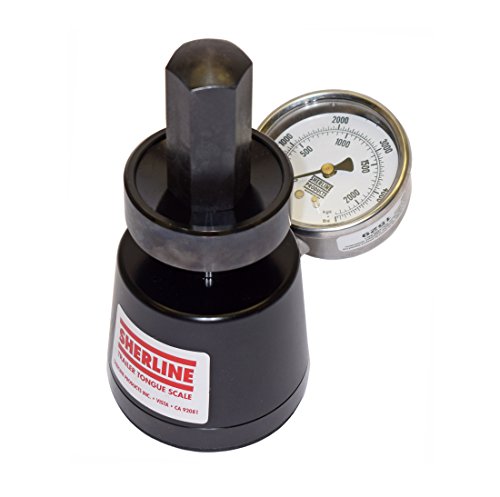
Sherline LM-5000 Trailer Tongue Weight Scale, 5,000 lb
$189.90Five thousand pounds, which is what it takes to weigh a fifth wheel pin rather than a bumper pull tongue.
Best for: Weighing fifth wheel pin weight at home.
Check price on Amazon
Sherline Hydraulic Tongue Weight Scale, 0 to 5,000 lb with dual scale gauge
$199.95Reads in both pounds and kilograms on one gauge, at 5,000 lb capacity.
Best for: Pin weight, with a metric reading for anybody who wants it.
Check price on Amazon
Sherline Hydraulic Tongue Weight Scale Combo with 2,000 lb and 5,000 lb Gauges
$229.95Two gauges on one scale body, so a 400 lb tongue weight can be read on the 2,000 lb gauge where the resolution is useful rather than squinted at on the 5,000 lb one.
Best for: Somebody weighing both a light trailer and a heavy one.
Check price on Amazon
B&W Digital Tongue Weight Scale
$149.00A digital readout rather than a dial, which removes the parallax error that makes a hydraulic gauge hard to read accurately when it is sitting on the ground under a trailer tongue.
Best for: Reading a figure precisely without lying on the driveway.
Check price on Amazon
Lynx Levelers, 11 pack with cap
$33.18Interlocking blocks that stack into a pyramid and do not squirt out sideways under load the way loose lumber does. The category standard, and the pack size most people need.
Best for: Levelling a travel trailer on an uneven site.
Check price on AmazonHow we chose
We did not test this hardware in person and we never claim to. Picks are researched from manufacturer specification sheets, published towing standards, and the recurring themes in verified owner reviews. Every pick is matched to a real gross trailer weight rating, a real tongue or pin weight rating, a real receiver size or a real load index rather than to a price bracket, and it is placed in the tier where its published capability actually belongs. We rejected the unbranded flood that dominates the search results in several of these categories, because a weight distribution hitch, a brake controller, a trailer tire and a set of safety chains are all parts whose failure puts a loose trailer on a public road. Where a figure is towing convention rather than a published standard we label it that way, and where a manufacturer does not publish a figure we leave it out instead of estimating it.
Frequently asked questions
What is the difference between dry weight and GVWR?
Dry weight, properly unloaded vehicle weight, is the trailer as it left the factory with no water, no propane, no batteries and no cargo. GVWR is the most the trailer may weigh loaded. The gap between them, minus the fluids and batteries, is your cargo carrying capacity. Dealer-installed options come out of that gap and are not reflected in the brochure dry weight.
How much can I load in a 3,000 lb trailer?
It depends entirely on the GVWR, which is why the brochure dry weight alone tells you nothing. With a 5,000 lb GVWR, a 26 gallon fresh tank, two propane cylinders and one battery, you have roughly 1,609 lb left. With a 4,000 lb GVWR the same trailer leaves far less. Read the cargo capacity label on the trailer itself.
How much does a full water tank weigh?
Water weighs 8.34 lb per US gallon, so a 40 gallon tank is 334 lb, a 50 gallon tank is 417 lb and a 100 gallon tank is 834 lb. The water heater holds another six gallons or so. On many trailers the fresh tank alone accounts for most of the cargo carrying capacity.
Does cargo capacity affect my tongue weight?
Yes, in two ways. Total tongue weight is a percentage of the loaded trailer weight, so adding cargo adds tongue weight proportionally. More importantly, WHERE you put the cargo changes the percentage: weight ahead of the trailer axle raises tongue weight and weight behind it lowers it, and a tail heavy load is what starts sway.
Are dealer-installed options included in the dry weight?
No, and this catches a lot of buyers. The brochure dry weight is the base trailer from the factory. A second air conditioner, a solar package, an upgraded awning, a generator prep, a washer and dryer prep and heavier furniture are all added afterwards and all come straight out of your cargo carrying capacity. The label applied to your specific trailer is the accurate figure.
What happens if I exceed the cargo carrying capacity?
You exceed the trailer GVWR, which means the axles, tires, brakes, springs and frame are all carrying more than they were specified for. Trailer tires are the usual first failure because they are already loaded close to their rating by design. It also puts you over weight legally, and an overweight trailer in a crash investigation is not a good place to be.
Free download
Get the complete tow rig setups emailed to you
Both ladders, conventional travel trailer and fifth wheel, at beginner, intermediate and expert budgets, every item priced and linked with a running total, plus a printable pre-trip weighing worksheet you can fill in at the scale.
One email with the setups. No sequence, no sharing your address, unsubscribe any time.
Researched, not professional advice. This page is compiled from published standards, manufacturer towing guides and product specifications, and owner-review consensus, not hands-on testing. Figures described as a rule of thumb are towing convention rather than published standards, and they are labelled that way wherever they appear. Nothing here overrides your own ratings. Work your payload sum before your tow rating, because payload is the limit that actually binds on most half ton trucks and nearly every SUV. Load a conventional trailer to 10 to 15 percent tongue weight and a fifth wheel to 15 to 25 percent pin weight, and never lighter: a tail heavy trailer is what starts sway. Weigh the rig loaded rather than trusting a brochure dry weight. A weight distribution hitch and a set of air bags both restore ride height and control, and neither one raises a single rating. Trailer brakes are required by state law above a threshold that varies by state, and a breakaway battery that has quietly gone flat is the normal condition of most trailers on the road.