Fifth wheel hitches
Fifth wheel or gooseneck: two different couplings for two different jobs
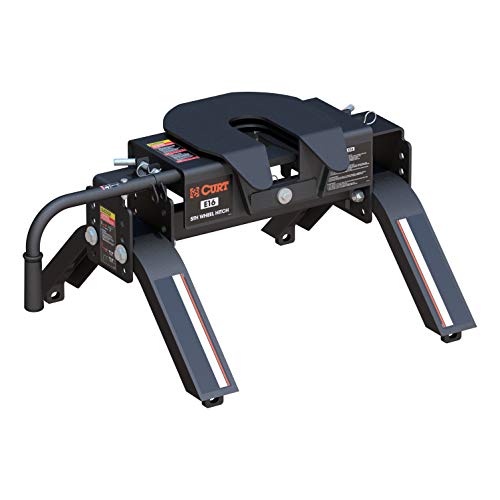
CURT E16 Fifth Wheel Hitch, 16,000 lb
$405.99A jaw-and-kingpin coupling on an articulating head, the standard connection for RV fifth wheels, rated at 16,000 lb.
Best for: A first fifth wheel hitch on a budget.
Check price on Amazon
B&W Turnoverball Gooseneck Hitch for Chevrolet and GMC 2500 and 3500
$694.88A ball mounted in the bed that flips over and drops flush when not towing, the simpler mechanical coupling favored for equipment and livestock trailers.
Best for: A truck that has to be a working truck between trips, and the foundation for a Companion fifth wheel.
Check price on AmazonA fifth wheel and a gooseneck both solve the truck-bed-mounted, over-the-axle coupling problem, and both are genuinely different from a travel trailer's receiver hitch for that reason. What separates the two from each other is the coupling mechanism itself. A fifth wheel wraps a set of jaws around a kingpin on an articulating head built to pivot smoothly through a turn. A gooseneck is mechanically simpler: a ball mounted in the bed floor and a coupler on the trailer, the same basic idea as a receiver hitch just moved forward and lowered into the bed.
CURT E16 Fifth Wheel Hitch, 16,000 lb is a straightforward, budget-friendly fifth wheel hitch built around the jaw-and-kingpin design. B&W Turnoverball Gooseneck Hitch for Chevrolet and GMC 2500 and 3500 is a gooseneck hitch whose ball flips over and drops flush into the bed floor when nothing is hitched, leaving the truck bed usable for actual work.
Neither one is simply a cheaper or nicer version of the other. Which one belongs on a given truck usually comes down to what is actually being hauled behind it.
What is mechanically different about how each one couples?
A fifth wheel wraps jaws around a kingpin on an articulating head; a gooseneck is a plain ball and coupler, mechanically simpler and typically less expensive at a comparable rating.
Rule of thumb Widely taught towing convention rather than a published specification. It is a good starting point and it is not a rating.
| Fifth wheel | Gooseneck | |
|---|---|---|
| Coupling mechanism | Wrap-around jaws around a kingpin | Ball and coupler |
| Head design | Articulating, built to pivot through a turn | Fixed ball, articulation comes from the coupler |
| Most common use | RV travel | Livestock, equipment, car haulers |
| Typical hardware cost at a given rating | Usually higher | Usually lower |
| Bed usage when not towing | Head stays mounted unless removed | Ball flips or drops flush on many designs |
These are general tendencies across the category. Specific models on both sides vary in price and bed clearance; check the exact hitch against your own truck bed.
Which one rides smoother?
A fifth wheel's articulating head, combined with a cushioned or air-ride pin box on the trailer side, is generally the smoother-riding of the two, because there is more engineered give between the trailer and the truck. GEN-Y Executive Torsion-Flex Fifth Wheel King Pin Box is a common upgrade specifically aimed at that ride quality, adding rubber torsion cushioning between the kingpin and the trailer frame.
A gooseneck's plain ball and coupler transmits more of the road directly, though it is not without its own smoothing options; some equipment and livestock trailers use cushioned couplers of their own. For a typical RV owner comparing the two as delivered, the fifth wheel's design generally has more built-in ride isolation from the factory.
Can a truck be set up to pull both types?
Yes, with the right adapter, and this catalog carries hardware for both directions. CURT 16085 Spyder Fifth Wheel to Gooseneck Adapter, 25,000 lb lets a fifth wheel trailer's kingpin couple to a truck's gooseneck ball, useful for an owner whose truck is already set up for gooseneck work. CURT 60639 OEM Puck Gooseneck Hitch Kit converts a factory puck system into a gooseneck ball outright. GEN-Y Nomad Fifth Wheel to Gooseneck Static Pin Box goes the other direction, replacing a fifth wheel trailer's own pin box with a gooseneck-style coupler so the trailer connects to a plain ball instead of a fifth wheel head.
Each of these is a genuine, purpose-built adapter rather than an improvised workaround, but check the trailer maker's own position on frame warranty before towing a fifth wheel RV through an adapter, since some manufacturers do not honour a frame warranty on a trailer towed that way.
Why do heavy equipment and livestock trailers favor gooseneck?
Mechanical simplicity and cost. A ball and coupler has fewer parts to inspect, grease and maintain than a jaw-and-kingpin head, and goosenecks are commonly available at high gross trailer weight ratings for a lower hardware price than an equivalently rated fifth wheel hitch. CURT 60639 OEM Puck Gooseneck Hitch Kit is rated for 38,000 lb of gross towing weight, well above the fifth wheel ratings in this catalog, which is typical of the category rather than an outlier.
None of that changes the loading math underneath either coupling type. Both a fifth wheel's pin weight and a gooseneck trailer's connection weight land fully on the truck's payload regardless of which mechanism is doing the coupling.
Frequently asked questions
Is a gooseneck hitch cheaper than a fifth wheel hitch?
Often, yes, at a comparable weight rating, because a ball and coupler has fewer moving parts than a jaw-and-kingpin articulating head. CURT E16 Fifth Wheel Hitch, 16,000 lb is the most affordable fifth wheel hitch in this catalog, but even it carries more hardware than a comparable gooseneck ball setup like B&W Turnoverball Gooseneck Hitch for Chevrolet and GMC 2500 and 3500. Compare specific models rather than assuming either category always wins on price.
Can I switch my truck from fifth wheel to gooseneck without buying a whole new trailer?
You can switch the truck side without a new trailer using an adapter such as CURT 60639 OEM Puck Gooseneck Hitch Kit, which converts a factory puck system into a gooseneck ball. Towing a fifth wheel trailer through a gooseneck-side adapter such as CURT 16085 Spyder Fifth Wheel to Gooseneck Adapter, 25,000 lb is also possible, though check the trailer manufacturer's frame warranty position on adapter towing first.
Why do RVs almost always use a fifth wheel rather than a gooseneck?
RV manufacturers generally build around the fifth wheel's articulating head and cushioned pin box options because they smooth the ride more than a plain ball and coupler, which matters more for a living space than for a flatbed or livestock trailer. The RV industry has also standardized its kingpin and pin box dimensions around the fifth wheel system for decades, which reinforces the pattern.
Does a gooseneck hitch leave the truck bed more usable?
Often yes, particularly on a flip-over design like B&W Turnoverball Gooseneck Hitch for Chevrolet and GMC 2500 and 3500, where the ball drops flush into the bed floor when nothing is hitched, leaving a nearly flat bed for hauling. A fixed fifth wheel head generally stays mounted and takes up bed space unless it is removed entirely, though some fifth wheel hitches are designed to unbolt for storage.
Does pin weight or gooseneck connection weight get treated differently by my truck?
No, both land on the same rear-axle-adjacent location in the bed and both count fully against the truck's payload rating, since neither coupling type includes any hardware that redistributes that weight elsewhere the way a travel trailer's weight distribution hitch does. Work the payload math the same way regardless of which coupling your trailer uses.
Which is safer for a first-time heavy trailer owner?
Neither coupling type is inherently safer; both depend on correct loading, a properly rated hitch, and a truck with enough payload for the connection weight. A first-time owner is generally better served by whichever type matches the trailer they are actually buying, since a gooseneck hitch does not fit a fifth wheel RV and a fifth wheel hitch does not fit a gooseneck equipment trailer.
Free download
Get the complete tow rig setups emailed to you
Both ladders, conventional travel trailer and fifth wheel, at beginner, intermediate and expert budgets, every item priced and linked with a running total, plus a printable pre-trip weighing worksheet you can fill in at the scale.
One email with the setups. No sequence, no sharing your address, unsubscribe any time.
Researched, not professional advice. This page is compiled from published standards, manufacturer towing guides and product specifications, and owner-review consensus, not hands-on testing. Figures described as a rule of thumb are towing convention rather than published standards, and they are labelled that way wherever they appear. Nothing here overrides your own ratings. Work your payload sum before your tow rating, because payload is the limit that actually binds on most half ton trucks and nearly every SUV. Load a conventional trailer to 10 to 15 percent tongue weight and a fifth wheel to 15 to 25 percent pin weight, and never lighter: a tail heavy trailer is what starts sway. Weigh the rig loaded rather than trusting a brochure dry weight. A weight distribution hitch and a set of air bags both restore ride height and control, and neither one raises a single rating. Trailer brakes are required by state law above a threshold that varies by state, and a breakaway battery that has quietly gone flat is the normal condition of most trailers on the road.