Fifth wheels around 17,000 lb
How much pin weight does a 17,000 lb fifth wheel have?
Pin weight is the fifth wheel equivalent of tongue weight, and it is far higher: the conventional band is 15 to 25 percent rather than 10 to 15. That is not an accident and it is not a problem. The load sits over the truck rear axle rather than hanging behind it, so the geometry that makes a heavy tongue dangerous on a bumper pull is simply not present here.
The consequence is payload. At 3,400 lb of pin weight plus roughly 200 lb of hitch, a 17,000 lb fifth wheel puts 3,600 lb into the bed before anything else. At this trailer weight that figure exceeds the entire payload of most half ton trucks and a good many three quarter ton ones, which is why fifth wheels of this size live behind one ton trucks.
Fifth wheels are also far more stable than bumper pulls, and for the same reason: there is no pendulum hanging behind the rear axle, so trailer sway in the conventional sense is close to a non-issue. What you get instead is chuck, the fore and aft jolt on every throttle change, which is a pin box and hitch design problem rather than a loading one.
On this page
What is 15 to 25 percent of 17,000 lb?
The working
Rule of thumbpin weight = trailer weight x percentage 15% of 17,000 lb = 2,550 lb 20% of 17,000 lb = 3,400 lb 25% of 17,000 lb = 4,250 lb on the truck = pin weight + hitch weight (about 200 lb)
Percentages are against the trailer as loaded. A fifth wheel gains weight faster than owners expect, because the front storage bay sits directly over the pin and everything put in it lands on the truck.
At 20 percent a 17,000 lb fifth wheel puts 3,400 lb on the pin, and about 3,600 lb on the truck once the hitch is counted.
Rule of thumb Widely taught towing convention rather than a published specification. It is a good starting point and it is not a rating.
| Percentage of trailer weight | Pin weight | On the truck with hitch | Where that sits |
|---|---|---|---|
| 13% | 2,210 lb | 2,410 lb | Below the conventional floor |
| 15% | 2,550 lb | 2,750 lb | Inside the band |
| 18% | 3,060 lb | 3,260 lb | Inside the band |
| 20% | 3,400 lb | 3,600 lb | Inside the band |
| 22% | 3,740 lb | 3,940 lb | Inside the band |
| 25% | 4,250 lb | 4,450 lb | Inside the band |
| 28% | 4,760 lb | 4,960 lb | Above the conventional ceiling |
The 15 to 25 percent band is towing convention rather than a published standard. Your trailer certification label states its own weights, and that is the figure to trust.
Why is pin weight so much higher than tongue weight?
Because the connection point is in a completely different place. A bumper pull hitches behind the tow vehicle rear axle, so tongue weight acts on a lever that lifts the front of the truck. A fifth wheel pin sits in the bed, ahead of or directly over the rear axle, so its weight presses down where the truck is strongest and barely disturbs the steer axle at all.
That is why the fifth wheel band can be 15 to 25 percent while the bumper pull band has to stay at 10 to 15. It is also why fifth wheels do not need weight distribution hitches or sway control: there is nothing to distribute and very little to damp. The trade is that all of that weight is payload, permanently.
Two numbers to check on the door jamb before anything else: payload, and the rear axle GAWR. A fifth wheel can exhaust the rear axle rating while the truck is still inside its GVWR, because the load is concentrated over one axle rather than spread along the vehicle.
Short bed trucks and the cab clearance problem
A standard fifth wheel hitch mounted in a six and a half foot bed does not have enough room for the trailer nose to swing past the cab in a sharp turn. At full lock, the front cap of the trailer arrives where the back of the cab is. This is not a theoretical clearance issue and it happens at parking lot speed, usually while somebody is reversing into a site.
There are three real answers. A sliding hitch moves the pin rearward for manoeuvring and locks forward for travel. An extended pin box moves the trailer coupling point forward relative to its own body, which buys the same clearance without a moving part in the truck. Or a gooseneck style coupling such as an in-bed ball mounted unit, which sits lower and further back. Measure your own clearance at full lock, slowly, with somebody watching, before you trust any of them.
How to weigh pin weight
- Weigh the whole rig hitched. At a public scale, with the trailer loaded and the truck loaded exactly as you will travel. Note the total and the individual axle weights.
- Unhitch and weigh the truck alone. Same scale, same trip, same fuel level. The difference in the truck weight between the two runs is your pin weight.
- Check the rear axle number specifically. The axle weights from the hitched run tell you whether the rear GAWR is exceeded, which a total weight cannot show you.
- Or use a scale rated above 4,250 lb. A tongue weight scale rated to 5,000 lb can take a pin weight directly if you can get the trailer onto it, which is harder than it sounds on a fifth wheel and is why the public scale method is usually easier.
- Re-weigh after you load the front bay. The front storage bay of a fifth wheel sits over the pin. Generators, tools and full water tanks put there transfer almost entirely onto the truck.
Hardware for a 17,000 lb fifth wheel
Chosen against the numbers on this page rather than from a general list, so the recommendation cannot contradict the arithmetic above. Every rating quoted is the manufacturer figure, and the rating on the part you receive is what governs.
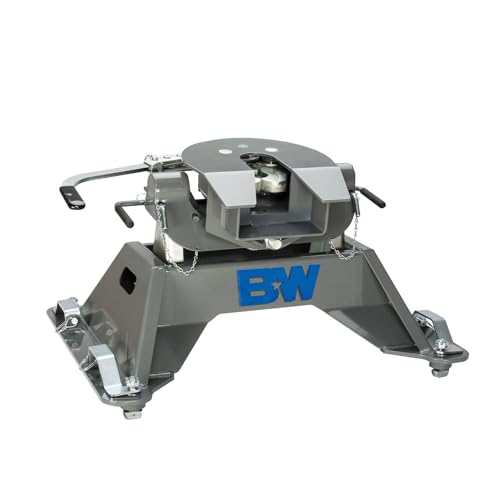
B&W Companion OEM Puck Fifth Wheel Hitch for Chevrolet and GMC, 25,000 lb
$1,399.00 Published ratingsThe 25,000 lb GM puck version, for a heavy fifth wheel or a toy hauler.
Best for: A GM dually or heavy duty truck with a large fifth wheel.
Check price on Amazon
CURT A25 Fifth Wheel Hitch for GM Puck System, 25,000 lb
$1,366.95 Published ratingsThe 25,000 lb CURT puck hitch, the heaviest rating in this catalog outside the B&W range.
Best for: A large toy hauler behind a GM dually.
Check price on Amazon
CURT A20 Fifth Wheel Hitch for GM Puck System, 20,000 lb
$1,311.95 Published ratingsCURT puck mounted hitch for Silverado and Sierra 2500 and 3500 with an 8 foot bed, at 20,000 lb.
Best for: A long bed GM heavy duty truck with factory pucks.
Check price on Amazon B&W Companion OEM Puck Fifth Wheel Hitch for Chevrolet and GMC, 20,000 lb
$1,199.00 Published ratingsThe GM puck version at 20,000 lb. Same no-rail install, lower rating and lower price than the 25K.
Best for: A GM truck with the factory puck system pulling a typical fifth wheel RV.
Check price on Amazon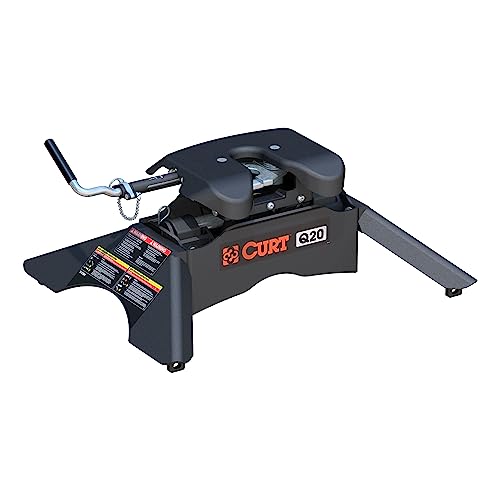
CURT Q20 Fifth Wheel Hitch, 20,000 lb
$599.99Twenty thousand pounds and a dual jaw design that wraps more of the kingpin than a single jaw, which is the difference you feel as less chuck when the throttle goes on and off.
Best for: A mid to large fifth wheel where ride quality matters.
Check price on Amazon
CURT 16204 Universal Fifth Wheel Base Rails, 25,000 lb
$124.95Industry standard base rails rated at 25,000 lb. Nearly every rail mounted fifth wheel and gooseneck hitch fits these, so the rails outlive the hitch.
Best for: A bed with no rails and no pucks.
Check price on AmazonHow we chose
We did not test this hardware in person and we never claim to. Picks are researched from manufacturer specification sheets, published towing standards, and the recurring themes in verified owner reviews. Every pick is matched to a real gross trailer weight rating, a real tongue or pin weight rating, a real receiver size or a real load index rather than to a price bracket, and it is placed in the tier where its published capability actually belongs. We rejected the unbranded flood that dominates the search results in several of these categories, because a weight distribution hitch, a brake controller, a trailer tire and a set of safety chains are all parts whose failure puts a loose trailer on a public road. Where a figure is towing convention rather than a published standard we label it that way, and where a manufacturer does not publish a figure we leave it out instead of estimating it.
Frequently asked questions
How much pin weight does a 17,000 lb fifth wheel put on the truck?
At the usual 20 percent it is about 3,400 lb of pin weight, plus roughly 200 lb for the hitch hardware itself, so around 3,600 lb total into the bed. Everything else in the truck, passengers included, comes out of what is left. Compare that directly against the payload figure on the yellow sticker in your driver door jamb.
Why is the fifth wheel pin weight band 15 to 25 percent?
Because the load sits over the truck rear axle instead of hanging behind it. A bumper pull tongue acts on a lever that lifts the steer axle, which is why its band has to stay at 10 to 15 percent. A fifth wheel pin presses down where the truck carries weight best, so a much higher percentage is both normal and desirable for stability.
Do I need sway control on a fifth wheel?
No. Sway control and weight distribution hitches exist to manage a trailer hanging behind the tow vehicle rear axle, and a fifth wheel does not hang there. The equivalent problem on a fifth wheel is chuck, the fore and aft jolt on throttle changes, and that is addressed with a cushioned pin box or a hitch with a wrapping jaw rather than with friction bars.
Can a half ton truck pull a fifth wheel?
We will not answer that for your truck and neither should anyone else, because it depends entirely on your payload sticker. What we can tell you is the arithmetic: a 17,000 lb fifth wheel puts roughly 3,600 lb into the bed with the hitch, and every passenger and every item of gear comes out of the same payload figure. Read your own sticker and do the subtraction.
What is chuck and how do I stop it?
Chuck is the fore and aft jolt you feel in the cab every time the throttle goes on or off, caused by slack and rigidity in the connection between the kingpin and the trailer frame. A hitch with a cam action jaw that wraps the pin removes the slack, and a cushioned pin box using rubber or coil springs absorbs what remains. Together they change the ride noticeably.
Does the front storage bay really matter that much?
Yes, more than any other loading decision on a fifth wheel. That bay sits directly over or ahead of the kingpin, so weight put there transfers almost entirely onto the truck rather than being shared with the trailer axles. A generator, a full set of tools and a couple of full water jugs in the front bay can add two hundred pounds straight onto your payload.
Free download
Get the complete tow rig setups emailed to you
Both ladders, conventional travel trailer and fifth wheel, at beginner, intermediate and expert budgets, every item priced and linked with a running total, plus a printable pre-trip weighing worksheet you can fill in at the scale.
One email with the setups. No sequence, no sharing your address, unsubscribe any time.
Researched, not professional advice. This page is compiled from published standards, manufacturer towing guides and product specifications, and owner-review consensus, not hands-on testing. Figures described as a rule of thumb are towing convention rather than published standards, and they are labelled that way wherever they appear. Nothing here overrides your own ratings. Work your payload sum before your tow rating, because payload is the limit that actually binds on most half ton trucks and nearly every SUV. Load a conventional trailer to 10 to 15 percent tongue weight and a fifth wheel to 15 to 25 percent pin weight, and never lighter: a tail heavy trailer is what starts sway. Weigh the rig loaded rather than trusting a brochure dry weight. A weight distribution hitch and a set of air bags both restore ride height and control, and neither one raises a single rating. Trailer brakes are required by state law above a threshold that varies by state, and a breakaway battery that has quietly gone flat is the normal condition of most trailers on the road.