Suspension
Which helper springs or air bags should you buy for towing?
Say it plainly before anything else on this page: a helper spring or an air bag does not add capacity of any kind. Not payload, not GVWR, not the rear axle's own GAWR. What it does is restore ride height and steady the suspension travel on a rear end that is squatting under tongue weight, which makes towing more comfortable and keeps the headlights aimed at the road instead of the treetops. That is the entire job, and it is genuinely useful, but it is a comfort and control upgrade riding on top of whatever capacity the truck already had, not a way to create more of it.
The dangerous version of this misunderstanding is specific: a truck that visibly squats under an overloaded trailer is showing you a real problem, and a truck that sits level with helper springs fitted is still overloaded if it was overloaded before you added them, just with the one obvious warning sign removed. Work your payload remaining sum before shopping this page, not after.
Two genuinely different mechanisms are sold here. Air springs, sold by exact vehicle fitment, inflate and deflate so ride height can be adjusted for the load and dropped back down when the trailer comes off. Rubber helper springs, from makers like Timbren, and closed-cell polyurethane springs from SuperSprings, are maintenance free, with nothing to inflate, no compressor, and nothing to leak on a cold morning; they engage progressively as the load comes on rather than being adjusted by the driver.
On this page
- What does this hardware actually change, and what does it not change?
- How we chose
- Beginner: adjustable air, lowest cost of entry
- Intermediate: maintenance free, buy it once
- Expert: the top of what this category offers
- Air versus rubber versus polyurethane, compared
- How do you know if you need this category at all?
- Does this hardware replace a weight distribution hitch?
What does this hardware actually change, and what does it not change?
It changes ride height and how much the rear suspension travels under load. Spring bars, air springs and rubber helper springs all work the same basic way: they add resistance low in the rear suspension travel, which reduces sag and the bouncing and bottoming out that comes with it. An air spring matched to a half ton truck's exact fitment and a rubber helper spring for that same class of truck both do this without touching a single number printed on the door jamb sticker.
What it cannot change is capacity that was never there. Payload, GVWR, GCWR and every axle rating are set by the manufacturer for the vehicle's structure, brakes and drivetrain, and no add-on suspension part alters any of them. This is true of every product on this page without exception.
How we chose
We did not install any of these ourselves. Picks come from the manufacturer's own published fitment, load-leveling figures and maintenance description, checked against the consensus of verified owner reviews for the specific application.
Beginner: adjustable air, lowest cost of entry
Air springs that adjust for the load and drop back down empty, at the lowest price in this category.

Air Lift 1000 Air Spring Kit for Ram 1500
$149.99Installs inside the factory rear coil spring and adjusts from 5 to 35 psi, sold by Air Lift for a Ram 1500's exact fitment rather than as a universal kit.
Check before buying: Air springs level the truck. They do not add payload capacity, they do not change the GVWR and they do not change the rear axle GAWR. Nothing in this category does.
Best for: A half ton pickup that squats visibly under a heavy tongue weight.
Check price on Amazon
Air Lift 1000 Air Spring Kit for Toyota 4Runner and Lexus GX460
$149.99The same adjustable air spring design in the fitment for a midsize SUV, which squats harder than a truck under the same tongue weight because it carries less rear spring over a shorter wheelbase.
Best for: An SUV towing a small to midsize travel trailer.
Check price on Amazon
Air Lift 1000 Air Spring Kit for Jeep Gladiator 4WD
$137.99The Jeep Gladiator fitment of the same adjustable air spring, for a long-wheelbase truck with a genuinely modest factory payload rating.
Best for: A Gladiator carrying a bed load or towing a small trailer.
Check price on AmazonIntermediate: maintenance free, buy it once
Nothing to inflate, nothing to leak, and nothing to check before every trip beyond a visual inspection.
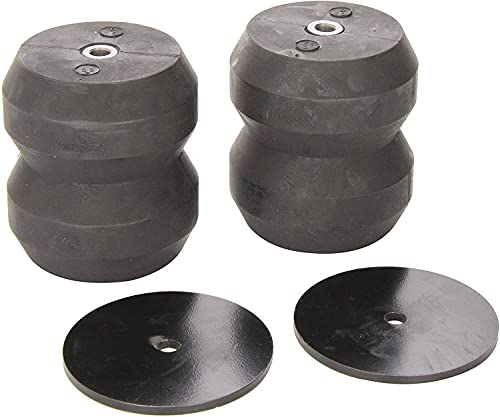
Timbren Suspension Enhancement System, rear kit for Chevrolet Silverado and GMC Sierra 1500
$269.36Progressive rubber springs that engage as the load comes on, with no air lines or compressor to maintain, sized for an older half ton GM truck's rear suspension.
Best for: A half ton GM truck owner who wants leveling with zero ongoing maintenance.
Check price on Amazon
Timbren SES Rear Suspension Enhancement System, 6,000 lb load support
$269.36The same maintenance-free rubber spring design in a fitment rated for 6,000 lb of load support.
Best for: A half ton Ford truck carrying tongue weight near the top of its payload.
Check price on Amazon
Timbren SES Rear Suspension Enhancement System, 8,600 lb load support
$258.00The GM half ton fitment rated for 8,600 lb of load support, for a truck that needs more margin than the lighter Timbren kits.
Best for: A half ton GM truck towing at the heavier end of its payload range.
Check price on AmazonExpert: the top of what this category offers
Heavier duty air, or a softer empty ride from a different maintenance-free material, for trucks working hardest.

Air Lift 1000 HD Air Spring Kit for Ram 1500
$213.99The heavy duty version of the Ram 1500 air spring kit, with a higher maximum inflation pressure for more support at the top of the payload range.
Best for: A Ram 1500 towing near the top of its published payload rating.
Check price on Amazon
Timbren Suspension Enhancement System, rear kit for Ford F-250 Super Duty
$258.00The maintenance-free rubber spring design scaled up for a heavier three quarter ton truck, rated by Timbren for up to 8,600 lb of load support with no air lines to route.
Best for: A heavier truck where the owner wants zero-maintenance leveling at a higher rating.
Check price on Amazon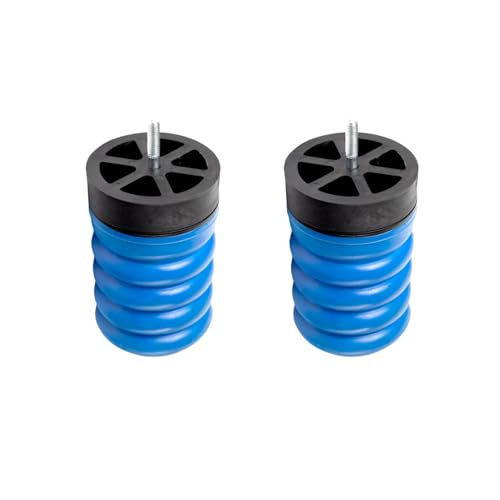
SuperSprings SumoSprings Rear Kit
$253.99Closed cell polyurethane springs that behave a little like air bags without any air in them, softening the empty, unloaded ride more than rubber does while still engaging progressively under load.
Best for: A truck that rides empty most of the time and is loaded only occasionally.
Check price on AmazonWho should not buy this tier: Skip this whole page, at every tier, if you are shopping for more payload or a higher GVWR. Nothing here changes either number. This category is also the wrong fix for a truck whose problem is worn-out factory springs rather than a heavy tongue weight; replace tired springs before adding a helper on top of them.
Air versus rubber versus polyurethane, compared
Every figure below comes from the maker's own published listing for that specific fitment.
None of the mechanisms below add capacity; the published figures describe load-leveling support, which is a ride characteristic, not a rating.
Published standard A published, traceable figure: a standards body, a federal regulation or a manufacturer specification states it.
| Type | Maintenance | Published support |
|---|---|---|
| Air spring, half ton truck fitment | Inflate and deflate, 5 to 35 psi | Up to 1,000 lb of load-leveling capacity |
| Air spring, heavy duty fitment | Inflate and deflate, higher max psi | Higher end of the same 1,000 lb leveling range |
| Rubber helper spring, GM half ton | None, no air lines | Up to 8,600 lb of load support |
| Polyurethane spring, half ton fitment | None, no air lines | Up to 1,000 lb of load-leveling capacity at 50 percent compression |
"Load support" and "load-leveling capacity" describe how much the part resists sag under load, not any change to the vehicle's own payload, GVWR or axle ratings.
How do you know if you need this category at all?
The trigger is a rear end that visibly squats under a loaded trailer's tongue weight, not a number on a chart. If the truck sits noticeably lower at the rear with the trailer hitched than it does empty, and the headlights aim measurably higher, leveling hardware is worth adding, provided the truck's payload covers the actual load in the first place. See air bags against helper springs for the fuller mechanism comparison, and payload against towing capacity for the arithmetic that has to come first regardless of which hardware you choose.
Does this hardware replace a weight distribution hitch?
No, and the two solve different parts of the same problem. A weight distribution hitch levers tongue weight off the tow vehicle's rear axle and onto the steer axle and the trailer's own axles, spreading the load across four tires instead of two. Helper springs and air bags do not move weight anywhere; they simply resist the sag at the axle it is already sitting on. Many owners run both together, and neither one raises capacity in either direction.
How we chose
We did not test this hardware in person and we never claim to. Picks are researched from manufacturer specification sheets, published towing standards, and the recurring themes in verified owner reviews. Every pick is matched to a real gross trailer weight rating, a real tongue or pin weight rating, a real receiver size or a real load index rather than to a price bracket, and it is placed in the tier where its published capability actually belongs. We rejected the unbranded flood that dominates the search results in several of these categories, because a weight distribution hitch, a brake controller, a trailer tire and a set of safety chains are all parts whose failure puts a loose trailer on a public road. Where a figure is towing convention rather than a published standard we label it that way, and where a manufacturer does not publish a figure we leave it out instead of estimating it.
Frequently asked questions
Do air bags or helper springs increase my payload capacity?
No. Neither air springs nor rubber or polyurethane helper springs raise payload, GVWR, GCWR or any axle rating. They resist sag and restore ride height at the axle they are installed on. A truck that was overloaded before you added them is still overloaded afterward, with the visible warning sign of a squatting rear end now hidden.
What is the difference between an air spring and a rubber helper spring?
An air spring is adjustable, inflated to match the current load and let back down when the trailer is off, and it requires a compressor or a hand pump. A rubber helper spring, like Timbren's, has nothing to inflate and engages progressively as weight comes on, trading adjustability for zero ongoing maintenance and nothing to leak.
Do I need helper springs if I already have a weight distribution hitch?
Possibly, but the two solve different problems. A weight distribution hitch moves tongue weight off the rear axle and onto the steer axle and trailer axles; helper springs resist sag at whatever weight remains on the rear axle after that. Many owners with a heavy tongue weight run both together, since neither one substitutes for the other.
Can I leave air springs aired up all the time?
You can, but it changes the empty ride quality, since the springs are stiffer when inflated and the ride firms up noticeably with no load aboard. Most owners deflate them close to empty when not towing and air back up before hitching, which is the adjustability an air spring is bought for in the first place.
Why choose polyurethane over rubber if both are maintenance free?
Polyurethane springs like SumoSprings are softer at the empty end of their travel than rubber springs like Timbren, so the unloaded ride is closer to stock. Rubber springs are simpler and have an extremely long track record. Both are genuinely maintenance free with no air lines to fail; the difference is mostly in empty-truck ride comfort.
Will helper springs fix a truck that sags even when empty?
No, and that is a sign of worn-out factory springs rather than a towing load problem. Helper springs and air bags are designed to engage under load and stay out of the way when the truck is empty. A truck sagging at rest needs its factory springs inspected and likely replaced before adding a helper spring on top of the underlying problem.
Free download
Get the complete tow rig setups emailed to you
Both ladders, conventional travel trailer and fifth wheel, at beginner, intermediate and expert budgets, every item priced and linked with a running total, plus a printable pre-trip weighing worksheet you can fill in at the scale.
One email with the setups. No sequence, no sharing your address, unsubscribe any time.
Researched, not professional advice. This page is compiled from published standards, manufacturer towing guides and product specifications, and owner-review consensus, not hands-on testing. Figures described as a rule of thumb are towing convention rather than published standards, and they are labelled that way wherever they appear. Nothing here overrides your own ratings. Work your payload sum before your tow rating, because payload is the limit that actually binds on most half ton trucks and nearly every SUV. Load a conventional trailer to 10 to 15 percent tongue weight and a fifth wheel to 15 to 25 percent pin weight, and never lighter: a tail heavy trailer is what starts sway. Weigh the rig loaded rather than trusting a brochure dry weight. A weight distribution hitch and a set of air bags both restore ride height and control, and neither one raises a single rating. Trailer brakes are required by state law above a threshold that varies by state, and a breakaway battery that has quietly gone flat is the normal condition of most trailers on the road.