Sway control
Which add-on sway control kit should you buy?
A friction sway control kit bolts a friction bar between the hitch and the trailer frame, resisting side-to-side motion once it starts. It is the right purchase for anyone who already owns, or is buying, a plain weight distribution hitch with no sway control built in, and the wrong purchase to reach for before checking tongue weight.
Too little tongue weight causes sway. A trailer is a pendulum hinged at the ball, and a tail-heavy load lengthens that pendulum while reducing the weight holding it steady, so a small yaw grows instead of damping out. A friction bar resists the growth once it starts; it does nothing about a loading problem that keeps causing it. Weigh your trailer with the tongue weight calculator and fix the loading before you add hardware.
If you are buying a hitch from scratch rather than adding to one you already own, our roundup of hitches with sway control built in is very often the better purchase, because integrated designs never need disconnecting for backing the way every kit on this page does.
On this page
What does a sway control kit actually fix, and what does it not fix?
It fixes a trailer that is correctly loaded but still gets pushed around by wind and passing trucks, by resisting the oscillation once it begins. It does not fix a trailer loaded tail-heavy, because tongue weight below the conventional 10 to 15 percent band is a loading problem, not a hardware problem, and no friction bar changes where the trailer's centre of mass sits. Fixing the loading is always the first move; the kit is the second layer, not the first.
How we chose
We did not tow with any of these ourselves. Picks come from the manufacturer's published fit and adjustability, checked against verified owner reviews, from CURT, Husky, Ultra-Fab, Shocker and Camco, all makers with a real parts and warranty path for a hitch-adjacent safety part.
Beginner: the standard add-on bar
The lowest cost way to add damping to a plain hitch that has none.

Ultra-Fab Ultra Sway Control
$44.78The cheapest credible friction bar in the catalog from an established RV parts maker, suited to a light trailer that only needs modest damping.
Best for: A light trailer that only needs modest damping.
Check price on Amazon
CURT 17200 Trailer Sway Control Kit for Weight Distribution Hitches
$64.99Adjustable friction that fits most weight distribution hitches, and comes off in seconds for backing.
Check before buying: A friction bar must be disconnected before backing sharply or reversing on a wet or icy surface, and the trailer-side ball is a separate part on some kits.
Best for: Adding sway control to a plain weight distribution hitch for the first time.
Check price on AmazonIntermediate: adjustable and kitted
Tunable friction, or a kit that removes the most common ordering mistake in this category.

Husky Towing 34715 Right Handed Adjustable Sway Control Kit
$69.98A dual friction brake pad design so damping can be turned up for a windy run and backed off for town driving.
Best for: Somebody who wants to tune the friction rather than accept one fixed setting.
Check price on Amazon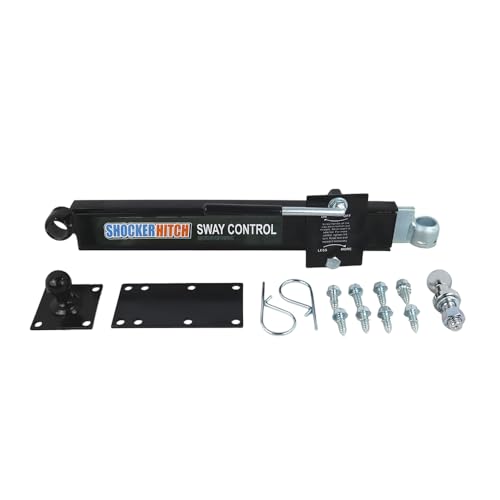
Shocker Sway Control Friction Arm Bar and Ball Kit
$92.92The arm and the trailer-mounted ball are supplied together, which removes the most common ordering mistake in this whole category.
Best for: A first sway control purchase where you do not want to work out which parts you need.
Check price on AmazonExpert: repeatable, exact settings
Screw adjustment rather than a friction pad set by feel, for a repeatable setting trip after trip.

Camco Eaz-Lift Screw On Adjustable Sway Control
$109.91Screw adjustment rather than friction set by feel, so a known good setting can be dialled back in exactly after removal for backing.
Best for: Repeating a known good setting trip after trip rather than eyeballing it each time.
Check price on AmazonWho should not buy this tier: Skip this whole page for a fifth wheel, which does not sway the way a bumper pull does and has nowhere to mount a friction bar, and skip it if your trailer sways with correct tongue weight and a hitch already rated for the load. That points at worn tires or a bent axle, not a missing sway kit.
How do the kits compare on price and adjustability?
Every figure is the manufacturer's own published price and description from the current catalog.
Prices in this category run from around $45 to around $110, and the difference is mostly adjustability rather than raw damping strength.
Published standard A published, traceable figure: a standards body, a federal regulation or a manufacturer specification states it.
| Kit | Adjustment method | Trailer ball included |
|---|---|---|
| Ultra-Fab Ultra Sway Control | Fixed friction, quick release lever | No |
| CURT 17200 Trailer Sway Control Kit for Weight Distribution Hitches | Adjustment bolt | No, see the CURT 17201 ball |
| Husky Towing 34715 Right Handed Adjustable Sway Control Kit | Dual friction pad, adjustable | Yes |
| Shocker Sway Control Friction Arm Bar and Ball Kit | Adjustable friction arm | Yes, two balls included |
| Camco Eaz-Lift Screw On Adjustable Sway Control | Screw adjustment, repeatable setting | No |
A friction bar and a trailer-mounted ball are frequently sold as separate parts. Check the "ball included" column before ordering, or you may receive a bar with nothing to mount it to.
Do you need the trailer-mounted ball too?
Frequently yes, and it is the most common thing buyers forget. The CURT trailer-mounted sway control ball bolts to the trailer frame and is the part a friction bar like the CURT 17200 actually clamps onto. If your kit does not list a ball as included, check whether your trailer already has one from a previous hitch before you order.
The failure mode is not subtle: the friction bar arrives, there is nothing on the trailer frame to attach its far end to, and the whole box sits in a garage until a second order goes out for the ball alone. That second shipping charge is frequently more than the ball itself cost. Read the kit's parts list line by line before checkout rather than after the box arrives, and if you are buying a used trailer, check the A-frame for an existing ball before assuming you need a new one.
How we chose
We did not test this hardware in person and we never claim to. Picks are researched from manufacturer specification sheets, published towing standards, and the recurring themes in verified owner reviews. Every pick is matched to a real gross trailer weight rating, a real tongue or pin weight rating, a real receiver size or a real load index rather than to a price bracket, and it is placed in the tier where its published capability actually belongs. We rejected the unbranded flood that dominates the search results in several of these categories, because a weight distribution hitch, a brake controller, a trailer tire and a set of safety chains are all parts whose failure puts a loose trailer on a public road. Where a figure is towing convention rather than a published standard we label it that way, and where a manufacturer does not publish a figure we leave it out instead of estimating it.
Frequently asked questions
Do I need a sway control kit if I already have a weight distribution hitch?
Only if your hitch has no sway control of its own. Some weight distribution hitches, like the Equal-i-zer or CURT TruTrack, build sway resistance into the head itself and do not need an add-on kit. A plain chain-and-bar or round-bar hitch with nothing else built in is the setup an add-on kit is meant for.
Will a sway control kit fix a trailer that sways badly?
Only if the underlying loading is correct. A friction bar resists an oscillation once it starts, but it cannot correct tongue weight that sits below the conventional 10 to 15 percent band, which is the actual cause of most sway. Weigh the trailer and fix the loading first, then add or check the sway kit.
Do I have to disconnect the sway bar to back up?
Yes, on every add-on kit in this category, before backing sharply or reversing on a wet or icy surface. Leaving it connected risks binding the trailer against the tow vehicle mid-turn. This is the main tradeoff against a hitch with sway control built into the head, which never needs disconnecting.
What is the trailer-mounted sway control ball, and do I need it separately?
It is the small ball that bolts to the trailer frame, which a friction sway bar clamps onto from the tow vehicle side. Some kits include it, some do not. Check your kit's listing before ordering, because a friction bar with nothing to mount it to is a common and avoidable ordering mistake.
Can I use two sway control kits on one trailer?
Yes, and some makers recommend it above roughly 10,000 lb of trailer weight, one kit per side of the A-frame, for more total resistance on a large or wind-catching trailer. Check the specific kit's own instructions, since not every design is sold or rated for a paired installation.
Is a sway control kit legally required?
No, sway control is not a legal requirement the way trailer brakes are above certain weights. It is a strong safety recommendation once a trailer is loaded correctly and still catches wind or passing traffic, and towing schools and hitch makers alike teach it as standard practice above roughly 5,000 lb.
Free download
Get the complete tow rig setups emailed to you
Both ladders, conventional travel trailer and fifth wheel, at beginner, intermediate and expert budgets, every item priced and linked with a running total, plus a printable pre-trip weighing worksheet you can fill in at the scale.
One email with the setups. No sequence, no sharing your address, unsubscribe any time.
Researched, not professional advice. This page is compiled from published standards, manufacturer towing guides and product specifications, and owner-review consensus, not hands-on testing. Figures described as a rule of thumb are towing convention rather than published standards, and they are labelled that way wherever they appear. Nothing here overrides your own ratings. Work your payload sum before your tow rating, because payload is the limit that actually binds on most half ton trucks and nearly every SUV. Load a conventional trailer to 10 to 15 percent tongue weight and a fifth wheel to 15 to 25 percent pin weight, and never lighter: a tail heavy trailer is what starts sway. Weigh the rig loaded rather than trusting a brochure dry weight. A weight distribution hitch and a set of air bags both restore ride height and control, and neither one raises a single rating. Trailer brakes are required by state law above a threshold that varies by state, and a breakaway battery that has quietly gone flat is the normal condition of most trailers on the road.