Weight distribution
Which weight distribution hitch has the best sway control built in?
A separate friction sway bar has to come off before you back sharply or reverse on a wet ramp, and it is the part most often left off after somebody skips that step once. A hitch with sway control built into the head never needs disconnecting, because the mechanism lives in the same joints that are already carrying the load.
Four genuinely different mechanisms show up on this page: 4-point integrated friction (Equal-i-zer), 2 or 4-point integrated friction with a different bracket geometry (CURT TruTrack), positive latching bars whose geometry resists sway (Blue Ox SwayPro), a friction cone under the ball (Andersen), and an active cam system that resists the start of a yaw rather than damping one already happening (Reese Dual Cam). None of them raises capacity; they only change how sway is resisted once the tongue weight is correct.
Get the loading right first with the trailer sway risk calculator. No mechanism here compensates for tongue weight that is too low, and too little tongue weight is the actual cause of most sway, not the absence of a sway bar.
On this page
- What counts as integrated sway control?
- How we chose
- Beginner: integrated sway control on a budget
- Intermediate: the buy-once pick
- Expert: the performance ceiling
- Friction, geometry or active cam: how do the mechanisms actually differ?
- Does integrated sway control cost you anything?
- When would you still add a separate sway bar?
What counts as integrated sway control?
Integrated means the sway resistance is part of the load path the spring bars already use, not a bolt-on part beside it. Equal-i-zer's 4-point design uses friction at four points where the bars meet the brackets. CURT's TruTrack uses adjustable friction brackets rather than a bar and chain. Andersen replaces spring bars entirely with tension chains and a friction cone under the ball. Reese's Dual Cam is the outlier: cams have to be pushed up a ramp to release, which means they resist the trailer starting to move sideways at all, rather than damping an oscillation once it has begun.
What none of them do is add capacity. A trailer that sways because it is loaded tail-heavy will still sway with any of these hitches fitted, just less severely and for less time.
How we chose
We did not tow behind any of these ourselves. Picks come from the manufacturer's own description of the sway mechanism and published rating, checked against verified owner reviews, and the unbranded VEVOR-and-clone flood described on our general weight distribution roundup is excluded here for the same reason: a sway mechanism under permanent spring tension is not a place to buy an unverified copy.
Beginner: integrated sway control on a budget
The cheapest way into a hitch that never needs a separate part disconnected.

CURT 17601 TruTrack 2P Weight Distribution Hitch with Sway Control, 10,000 lb
$398.78Two points of integrated friction rather than four, at a price closer to a plain hitch than to the Equal-i-zer.
Best for: A reader who wants integrated sway control without stepping up to the Equal-i-zer price.
Check price on Amazon
Camco Eaz-Lift ReCurve R3 Weight Distribution Hitch Kit, 1,000 lb
$490.91 Published ratingsA 2-5/16 inch ball is included and sway control is integrated, from a maker whose parts stay available for years.
Best for: A travel trailer in the 8,000 to 10,000 lb range on a first weight distribution purchase.
Check price on AmazonIntermediate: the buy-once pick
Sway control that will not need replacing when the next trailer is bigger.

Equal-i-zer 4-point Sway Control Hitch, 10,000 lb
$552.69 Published ratingsThe most reviewed integrated sway mechanism in this catalog, rated for a 10,000 lb trailer with no separate bar to manage.
Check before buying: The four point design is audible. A rhythmic creak on slow tight turns is normal for this hitch and not a fault, but people who have not been warned about it return them.
Best for: A single or tandem axle travel trailer where one part should do both jobs.
Check price on Amazon
Andersen Weight Distribution Hitch, 2 inch shank, 4 inch drop or rise
$789.98 Published ratingsA friction cone rather than steel bars, which is a fraction of the weight of every other hitch here and can be lifted by one person alone.
Check before buying: The urethane cones are a wear item and need re-greasing on a schedule. Skipping that is the source of most of the noise complaints about this hitch.
Best for: Somebody who hitches alone or has struggled to lift a conventional head onto the shank.
Check price on Amazon
Husky Center Line TS-Plus Weight Distribution Hitch, 400 to 800 lb tongue weight
$512.85 Published ratingsHusky rates this one by a tongue weight range rather than a single ceiling, an honest way to sell bars that must bracket the load rather than merely stay under a maximum.
Best for: A trailer whose weighed tongue weight lands between 400 and 800 lb.
Check price on AmazonExpert: the performance ceiling
The most sophisticated sway mechanisms, for trailers and routes where it matters most.

Reese Dual Cam II Weight Distribution Hitch with Active Sway Control, 8,000 lb
$869.09Cam sway control resists the START of a yaw instead of damping one already underway, the only mechanism on this page that works that way.
Check before buying: Cam systems are more setup sensitive than friction. Bracket position and bar tension have to be right or the cams will not seat, and that is a measuring job rather than a feel job.
Best for: Long trailers on windy interstate routes, where preventing the first yaw matters more than damping the third.
Check price on Amazon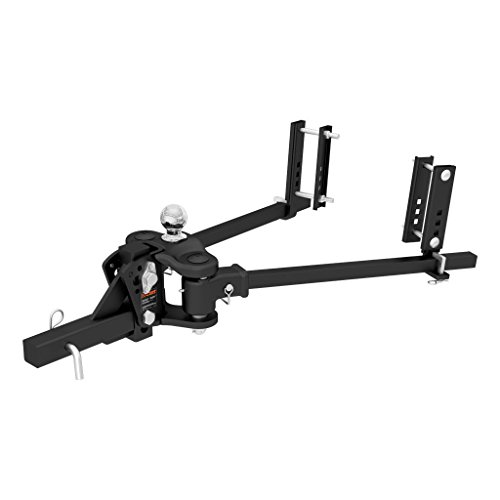
CURT 17500 TruTrack 4P Weight Distribution Hitch with Sway Control, 10,000 lb
$609.95Four points of integrated friction rather than two, for tall slab-sided trailers that catch crosswind and passing trucks.
Best for: A trailer that gets pushed around by passing traffic more than most.
Check price on Amazon
Equal-i-zer 4-point Sway Control Hitch, 16,000 lb
$745.35 Published ratingsThe top of the integrated friction range at 16,000 lb, for the heaviest bumper pull trailers behind a Class V receiver.
Best for: The largest bumper pull trailer on the market, provided your receiver carries the rating.
Check price on AmazonWho should not buy this tier: Skip this tier if your trailer is light and towed a few times a year, and skip all of it for a fifth wheel: fifth wheels do not sway the way a bumper pull does, and none of these mechanisms bolt to one.
Friction, geometry or active cam: how do the mechanisms actually differ?
Every description below is the manufacturer's own account of how the mechanism works, from the published listing.
Four distinct mechanisms are sold as "integrated sway control", and only the active cam design resists a yaw before it starts rather than damping one already moving.
Published standard A published, traceable figure: a standards body, a federal regulation or a manufacturer specification states it.
| Hitch | Mechanism | Disconnects for backing? |
|---|---|---|
| Equal-i-zer 4-point Sway Control Hitch, 10,000 lb | 4-point integrated friction | No |
| CURT 17601 TruTrack 2P Weight Distribution Hitch with Sway Control, 10,000 lb | 2-point integrated friction | No |
| CURT 17500 TruTrack 4P Weight Distribution Hitch with Sway Control, 10,000 lb | 4-point integrated friction | No |
| Blue Ox BXW1500 SwayPro Weight Distributing Hitch, 15,000 lb | Positive latching, geometry based | No |
| Andersen Weight Distribution Hitch, 2 inch shank, 4 inch drop or rise | Friction cone, integrated | No |
| Reese Dual Cam II Weight Distribution Hitch with Active Sway Control, 8,000 lb | Active cam, resists yaw onset | No, cams reset automatically on straightening |
Compare this against an add-on friction bar, which must be unhooked before backing sharply. None of the hitches in this table need that step.
Does integrated sway control cost you anything?
Two real tradeoffs. Price: every hitch above costs more than the plain version of the same model with no sway control. And noise: the 4-point friction design produces an audible creak on slow, tight turns, which is normal for that mechanism and not a defect, but catches owners off guard when nobody has warned them about it. Weigh that against a separate friction bar, which is cheaper up front and quieter, but has to be remembered and disconnected every time you back up.
When would you still add a separate sway bar?
If you already own a plain weight distribution hitch with no sway control and it is correctly rated, adding a kit from our best sway control kits roundup is cheaper than replacing the whole hitch. See the full breakdown in our integrated against add-on comparison and the friction against cam comparison if you are choosing between mechanisms rather than between integrated and add-on.
How we chose
We did not test this hardware in person and we never claim to. Picks are researched from manufacturer specification sheets, published towing standards, and the recurring themes in verified owner reviews. Every pick is matched to a real gross trailer weight rating, a real tongue or pin weight rating, a real receiver size or a real load index rather than to a price bracket, and it is placed in the tier where its published capability actually belongs. We rejected the unbranded flood that dominates the search results in several of these categories, because a weight distribution hitch, a brake controller, a trailer tire and a set of safety chains are all parts whose failure puts a loose trailer on a public road. Where a figure is towing convention rather than a published standard we label it that way, and where a manufacturer does not publish a figure we leave it out instead of estimating it.
Frequently asked questions
Is integrated sway control better than an add-on friction bar?
It is more convenient rather than automatically stronger for the same tongue weight. Integrated designs never need disconnecting for backing, while an add-on bar must be unhooked before reversing sharply or on a wet or icy ramp. Both are damping the same underlying physics; buy integrated for convenience and buy add-on to save money on an otherwise correct plain hitch.
What is the difference between friction and cam sway control?
Friction bars and brackets damp an oscillation once the trailer has already started to yaw. A cam system, used on the Reese Dual Cam, resists the trailer leaving the straight-ahead position in the first place, because the cams have to be pushed up a ramp before the trailer can move sideways at all. That makes it the only mechanism here that prevents rather than damps.
Why does my 4-point hitch creak on tight turns?
A rhythmic creak on slow, tight turns is normal on 4-point integrated friction hitches like the Equal-i-zer, caused by the friction surfaces moving against each other at low speed. It is not a sign of failure. It surprises new owners mainly because nobody warns them about it before the first parking-lot turn.
Does a friction cone hitch need grease like a spring bar hitch?
No, and that is the point of the design. Andersen's friction cone and tension chain system is built to skip the grease zerks that conventional spring bar heads need on a schedule. It still needs the cones inspected for wear over time, which is a different maintenance item than lubrication, not an absence of maintenance entirely.
Can I add sway control to a hitch that already has some built in?
You generally would not need to, since integrated designs are sized to the hitch's own rating. If a trailer still sways with an integrated hitch correctly fitted, the more likely cause is tongue weight below the 10 to 15 percent band, an overloaded rear trailer compartment, or worn tires, not insufficient sway hardware.
Do fifth wheels need sway control?
No. Sway control exists to manage a trailer hanging behind the tow vehicle rear axle, which is the bumper pull geometry. A fifth wheel pin sits over the axle rather than behind it, so there is very little to sway in the first place. The equivalent fifth wheel complaint is chuck, a fore and aft jolt, which a cushioned pin box addresses instead.
Free download
Get the complete tow rig setups emailed to you
Both ladders, conventional travel trailer and fifth wheel, at beginner, intermediate and expert budgets, every item priced and linked with a running total, plus a printable pre-trip weighing worksheet you can fill in at the scale.
One email with the setups. No sequence, no sharing your address, unsubscribe any time.
Researched, not professional advice. This page is compiled from published standards, manufacturer towing guides and product specifications, and owner-review consensus, not hands-on testing. Figures described as a rule of thumb are towing convention rather than published standards, and they are labelled that way wherever they appear. Nothing here overrides your own ratings. Work your payload sum before your tow rating, because payload is the limit that actually binds on most half ton trucks and nearly every SUV. Load a conventional trailer to 10 to 15 percent tongue weight and a fifth wheel to 15 to 25 percent pin weight, and never lighter: a tail heavy trailer is what starts sway. Weigh the rig loaded rather than trusting a brochure dry weight. A weight distribution hitch and a set of air bags both restore ride height and control, and neither one raises a single rating. Trailer brakes are required by state law above a threshold that varies by state, and a breakaway battery that has quietly gone flat is the normal condition of most trailers on the road.