Tools and maintenance
Which torque wrench should you use on trailer wheels?
A trailer wheel that comes off at highway speed is a projectile, not a breakdown, and the single biggest cause of it is lug nuts that were never torqued to a real number in the first place, or that were torqued once and never rechecked. New or freshly serviced wheels bed in against the hub over the first few miles of driving, which lets the clamping force drop even when the original torque was correct. Trailer lug nuts must be torqued to spec and rechecked after the first 50 miles, every time a wheel comes off and goes back on.
A torque wrench is also the right tool for one other job on the rig that gets skipped almost as often: the nut that holds a hitch ball onto its shank. A 2-5/16 inch ball, common on heavier trailers and fifth wheel to gooseneck adapters, frequently calls for torque well above what a typical 150 ft-lb wrench can reach, and a ball that is not torqued to spec can work loose under the constant flex of towing.
Buy against the actual range you need rather than the cheapest wrench on the shelf. See the lug nut torque chart for trailer wheels for published figures by stud size, and confirm your own axle's spec against its own hub or owner's documentation before you tighten anything.
On this page
- Why does a trailer wheel need re-torquing after 50 miles?
- How we chose these wrenches
- Beginner: covers the lug nut range for less
- Intermediate: clearer scale, a wider range, or a walk-in warranty
- Expert: reaching the torque a ball nut actually needs
- How do the ranges compare?
- Why does a 2-5/16 inch ball need so much more torque?
- What else belongs in the same pre-trip check as torque?
Why does a trailer wheel need re-torquing after 50 miles?
New or reinstalled wheels seat against the hub face under real load for the first time once the trailer is rolling, and that seating lets the mating surfaces compress slightly even after correct torque was applied at installation. The result is a small, real drop in clamping force that a wheel sitting still in the driveway will never show you. Re-checking torque after the first 50 miles catches that drop before it becomes a loose wheel at speed, and it is a five minute check against a wheel coming off entirely.
How we chose these wrenches
We did not use any of these ourselves. Picks come from the manufacturer's own published torque range, drive size and calibration tolerance, checked against the consensus of verified owner reviews for accuracy holding up over repeated use.
Beginner: covers the lug nut range for less
The lowest cost way to stop guessing at trailer lug nut torque.

EPAuto 1/2 inch Drive Click Torque Wrench, 10 to 150 ft-lb
$35.87A 10 to 150 ft-lb range covers the 90 to 120 ft-lb band most trailer lug nuts want, at the lowest credible price in this category. A wrench you own beats a spec you guessed at.
Best for: A first torque wrench bought specifically for trailer wheels.
Check price on AmazonIntermediate: clearer scale, a wider range, or a walk-in warranty
Still inside the common lug nut range, with something extra beyond the base price.

LEXIVON 1/2 inch Drive Click Torque Wrench, 10 to 150 ft-lb
$44.97The same 10 to 150 ft-lb range as the entry pick, with a clearer dual scale, a hard case, and a calibration certificate with a traceable serial number.
Best for: A wrench that will see regular use on both the truck and the trailer.
Check price on Amazon
CRAFTSMAN Torque Wrench, 1/2 inch Drive, 50 to 250 ft-lb
A 50 to 250 ft-lb range from a brand with over the counter warranty support, worth something on a tool meant to last two decades rather than one towing season.
Best for: A reader who wants a walk-in warranty rather than a return shipment.
Check price on AmazonExpert: reaching the torque a ball nut actually needs
The range to cover a 2-5/16 inch ball nut as well as every lug nut on the rig.
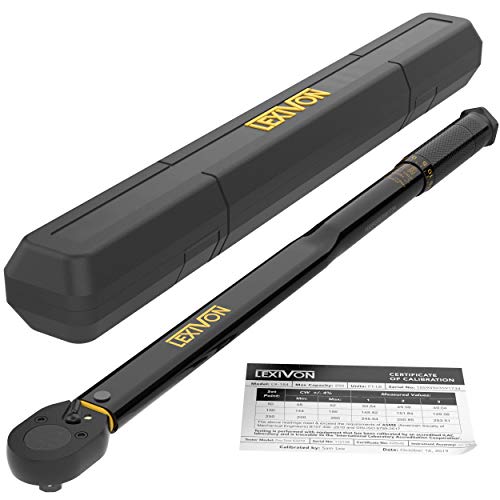
LEXIVON 1/2 inch Drive Click Torque Wrench, 25 to 250 ft-lb
$69.97A 25 to 250 ft-lb range reaches the torque many 2-5/16 inch ball nuts and heavy duty truck lugs call for, which a 150 ft-lb wrench simply cannot do regardless of how hard you pull on the handle.
Best for: Torquing a hitch ball nut correctly, in addition to lug nuts.
Check price on AmazonWho should not buy this tier: Skip this tier if you only ever torque lug nuts within a 150 ft-lb range and never install or service a hitch ball yourself. The extra range only matters once a ball nut, a heavier truck lug spec, or another fastener above 150 ft-lb enters the picture.
How do the ranges compare?
Every range below is the manufacturer's own published figure for that specific wrench.
Only the 25 to 250 ft-lb wrench in this table reaches high enough for many 2-5/16 inch hitch ball nuts; the rest are sized for lug nuts alone.
Published standard A published, traceable figure: a standards body, a federal regulation or a manufacturer specification states it.
| Wrench | Drive | Torque range |
|---|---|---|
| EPAuto 1/2 inch Drive Click Torque Wrench, 10 to 150 ft-lb | 1/2 in | 10 to 150 ft-lb |
| LEXIVON 1/2 inch Drive Click Torque Wrench, 10 to 150 ft-lb | 1/2 in | 10 to 150 ft-lb |
| CRAFTSMAN Torque Wrench, 1/2 inch Drive, 50 to 250 ft-lb | 1/2 in | 50 to 250 ft-lb |
| LEXIVON 1/2 inch Drive Click Torque Wrench, 25 to 250 ft-lb | 1/2 in | 25 to 250 ft-lb |
Confirm your own trailer axle's specified lug nut torque and your hitch ball's stamped torque figure before tightening; both vary by manufacturer and stud or thread size.
Why does a 2-5/16 inch ball need so much more torque?
The ball nut clamps a larger diameter thread and carries the entire tongue weight and hitching shock load through that one joint, so hitch makers publish a correspondingly higher torque figure than a lug nut ever needs. The exact figure is stamped on the ball itself or stated in the manufacturer's own installation instructions, and it commonly sits well above what a 150 ft-lb lug nut wrench can deliver. Buying a wrench that stops short of that number does not make the ball safe at a lower torque; it just means the ball was never actually torqued to spec. See our best trailer hitch balls roundup for the balls this applies to.
What else belongs in the same pre-trip check as torque?
Torquing wheels is one line item on a longer list. Follow the full pre-trip towing inspection and keep a copy of the first trip towing checklist in the truck, since a wheel that was correctly torqued at the shop and never rechecked after 50 miles is a preventable failure rather than a random one.
How we chose
We did not test this hardware in person and we never claim to. Picks are researched from manufacturer specification sheets, published towing standards, and the recurring themes in verified owner reviews. Every pick is matched to a real gross trailer weight rating, a real tongue or pin weight rating, a real receiver size or a real load index rather than to a price bracket, and it is placed in the tier where its published capability actually belongs. We rejected the unbranded flood that dominates the search results in several of these categories, because a weight distribution hitch, a brake controller, a trailer tire and a set of safety chains are all parts whose failure puts a loose trailer on a public road. Where a figure is towing convention rather than a published standard we label it that way, and where a manufacturer does not publish a figure we leave it out instead of estimating it.
Frequently asked questions
What torque should trailer lug nuts be set to?
It depends on the stud size and thread pitch your specific axle uses, published by the axle manufacturer rather than by a single universal figure. See the lug nut torque chart for trailer wheels for common stud sizes and their typical published ranges, and confirm the exact number against your own axle's documentation before tightening.
Why do trailer lug nuts need to be rechecked after the first 50 miles?
A freshly mounted or reinstalled wheel beds in against the hub face once it is actually rolling under load, which can let clamping force drop even when the original torque was correct. Rechecking after roughly the first 50 miles catches that drop before it becomes a loose wheel, and it is a five minute check every time a wheel comes off and goes back on.
Can a 150 ft-lb torque wrench torque a hitch ball nut?
Often not fully. A 2-5/16 inch ball nut carries the full tongue weight through one large threaded joint, and many manufacturers publish a torque spec well above 150 ft-lb for it. A wrench that stops at 150 ft-lb will click before reaching that number, leaving the ball under-torqued even though the wrench indicated it was done.
What happens if a trailer wheel is under-torqued?
The wheel can work loose over miles of vibration, eventually separating from the hub while the trailer is moving. A trailer wheel that comes off at highway speed becomes a projectile in traffic, not simply a roadside inconvenience, which is why correct torque and the 50 mile recheck are treated as safety steps rather than optional maintenance.
Do I need a separate torque wrench for the truck and the trailer?
Not necessarily. A single 1/2 inch drive wrench covering roughly 10 to 150 ft-lb handles most truck and trailer lug nuts alike. A second wrench only becomes worth owning if you also torque a hitch ball nut or another fastener that calls for more than 150 ft-lb, which a lug-nut-only wrench cannot reach.
How often should a click-type torque wrench be recalibrated?
Most manufacturers recommend checking calibration roughly once a year with normal use, or sooner if the wrench is dropped or used far outside its rated range regularly. Storing it at its lowest setting rather than left cranked to a high torque between uses is the simplest way to protect the internal spring and keep it accurate longer.
Free download
Get the complete tow rig setups emailed to you
Both ladders, conventional travel trailer and fifth wheel, at beginner, intermediate and expert budgets, every item priced and linked with a running total, plus a printable pre-trip weighing worksheet you can fill in at the scale.
One email with the setups. No sequence, no sharing your address, unsubscribe any time.
Researched, not professional advice. This page is compiled from published standards, manufacturer towing guides and product specifications, and owner-review consensus, not hands-on testing. Figures described as a rule of thumb are towing convention rather than published standards, and they are labelled that way wherever they appear. Nothing here overrides your own ratings. Work your payload sum before your tow rating, because payload is the limit that actually binds on most half ton trucks and nearly every SUV. Load a conventional trailer to 10 to 15 percent tongue weight and a fifth wheel to 15 to 25 percent pin weight, and never lighter: a tail heavy trailer is what starts sway. Weigh the rig loaded rather than trusting a brochure dry weight. A weight distribution hitch and a set of air bags both restore ride height and control, and neither one raises a single rating. Trailer brakes are required by state law above a threshold that varies by state, and a breakaway battery that has quietly gone flat is the normal condition of most trailers on the road.